

Supply chain leaders face a visibility crisis today. McKinsey found that only one-third of managers understand their risks well. You need a solid system for SCM reports to stay ahead.
Companies using supply chain optimization cut costs by 10% or more. Good inventory management also speeds up your cash flow. If you use data to find waste, you win.
This guide shows you 12 ways to track your supply chain KPI using accurate SCM reports. These tools improve supply chain visibility, refine demand forecasting, and stop errors before they happen. Let’s look at the metrics that matter.
A) Core Supply Chain Performance and Operational Reporting
Smart supply chain optimization starts with clear data. You need SCM reports to track daily tasks and stop small issues from growing. When you master inventory management, you save time and money.
These SCM reports ensure your supply chain visibility stays high across every department.
Report 1. On-Time in Full (OTIF) Performance Report
This supply chain KPI tracks your on-time delivery success. It shows if you meet customer needs without shipping errors. These SCM reports help you find late shipments by vendor or route. Steady on-time delivery builds loyalty and proves your supply chain optimization strategy works.
Impacts:
- Strengthens customer relationships.
- Reduces expensive shipping errors.
- Streamlines your billing process.
Report 2. Inventory Turnover and Days of Supply Report
Your inventory turnover rate shows how fast products move. Use these SCM reports to check if your inventory management is efficient. A high inventory turnover means you aren’t wasting money on storage. This supply chain KPI keeps your cash flowing and your warehouse lean.
Impacts:
- Frees up working capital.
- Cuts down on warehouse waste.
- Optimizes your storage space.
Report 3. Lead Time Analysis and Optimization Report
These SCM reports track lead time metrics from order to arrival. You need to know how long suppliers take to deliver. Tracking lead time metrics helps you plan better and avoid stockouts. Use this data to improve your supply chain optimization and set realistic goals.
Impacts:
- Lowers the need for safety stock.
- Makes your planning more accurate.
- Identifies slow-moving supply partners.
Report 4. Demand Forecast Accuracy Report
Accurate demand forecasting keeps your stock levels balanced. Use these SCM reports to compare your sales predictions against actual results. When you improve demand forecasting, you prevent overstocking and lost sales. This supply chain optimization tool helps you refine your inventory management plans for the next quarter.
Impacts:
- Reduces excess stock costs.
- Prevents missed sales opportunities.
- Improves production scheduling.
Report 5. Warehouse and Inventory Performance Report
Track warehouse metrics to see how fast your team picks and packs orders. These SCM reports highlight bottlenecks in your storage and shipping areas. Better warehouse metrics mean faster order fulfillment and better inventory management. Use this supply chain KPI to keep your facility running at peak speed.
Impacts:
- Increases labor productivity.
- Speeds up order shipping times.
- Lowers facility operating costs.
Report 6. Supplier Scorecard and Performance Report
A supplier scorecard rates your vendors on quality and speed. These SCM reports help you decide which partners support your supply chain optimization goals. By tracking a supplier scorecard, you hold vendors accountable. This data is vital for inventory management and long-term supply stability.
Impacts:
- Improves vendor quality levels.
- Lowers procurement risk factors.
- Provides leverage for negotiations.
B) Cost Management and Financial SCM Reporting
Managing costs ensures your business stays profitable. These SCM reports track every dollar spent on moving and storing goods. By focusing on supply chain optimization, you can find hidden expenses and cut them.
Effective inventory management relies on these financial SCM reports to keep your budget on track and your cash flow healthy.
Report 7. Freight and Transportation Cost Report
These SCM reports monitor your total shipping spend across all carriers and routes. You can see which lanes cost the most and where you can save. Tracking these costs is a vital part of supply chain optimization. It helps you manage your logistics performance and choose the best shipping methods.
Impacts:
- Lowers total shipping expenses.
- Improves carrier selection.
- Identifies cheaper shipping lanes.
Report 8. Inventory Carrying Cost and Holding Analysis
Every item in your warehouse costs money to keep. These SCM reports calculate the price of storage, insurance, and taxes. High carrying costs hurt your inventory management efficiency. Use this supply chain KPI to justify cleaning out old stock and improving your supply chain optimization efforts.
Impacts:
- Reduces overhead expenses.
- Minimizes product obsolescence.
- Improves overall profitability.
Report 9. Procurement Spend Analysis and Variance Report
Use procurement analytics to track what you buy and from whom. These SCM reports show if you are staying within your budget. By reviewing procurement analytics, you can spot price spikes or unauthorized spending. This data supports better inventory management and helps you negotiate better deals with your suppliers.
Impacts:
- Prevents budget overruns.
- Increases contract compliance.
- Finds volume discount opportunities.
C) Risk Management and Compliance SCM Reporting
Staying ahead of risks keeps your operations resilient. These SCM reports track potential threats and help you stay compliant. Good supply chain optimization means planning for the unexpected.
Use these SCM reports to build a shield around your inventory management strategy and ensure supply chain visibility when things go wrong.
Report 10. Supplier Risk and Compliance Report
This report assesses the safety and legal status of your vendors. These SCM reports show if your partners follow rules and meet safety standards. Tracking risk is a core part of supply chain optimization. It helps you avoid sudden shutdowns and protects your inventory management from bad supplier performance.
Impacts:
- Lowers legal risk factors.
- Avoids sudden supply gaps.
- Protects your brand reputation.
Report 11. Demand Variability and Disruption Impact Report
Measure how much your orders shift during a crisis. Use these SCM reports to see how shocks affect your logistics performance. This data helps you adjust your supply chain optimization plan. By knowing your limits, you can improve your inventory management and keep products moving during tough times.
Impacts:
- Better crisis response plans.
- Reduced stockout risks.
- Stable delivery schedules.
Report 12. Supply Chain Resilience and Performance Score
This final supply chain KPI combines all your data into one health score. These SCM reports show how well you handle stress. A high resilience score proves your supply chain optimization works. It gives you a clear view of your inventory management health and overall supply chain visibility.
Impacts:
- Clearer strategic planning.
- Faster recovery from shocks.
- Better overall business health.
These SCM reports protect your supply chain optimization and keep your inventory management safe from hidden risks.
12 Essential SCM Reports: At a Glance:
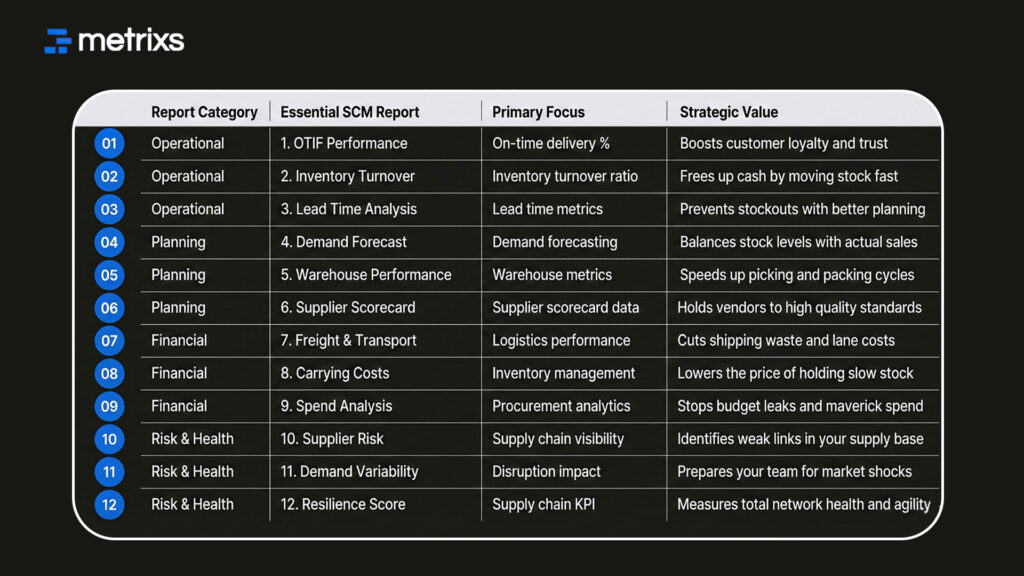
Use this table to quickly identify which SCM reports your team needs to improve supply chain optimization and refine your inventory management strategy.
How Metrixs Can Help You Master SCM Reporting
Metrixs transforms your data into a powerful tool for supply chain optimization. Our platform integrates with Microsoft Dynamics 365 to turn raw numbers into clear SCM reports.
With over 1,000 metrics, you can automate your inventory management and improve supply chain visibility instantly.
Key Strengths:
- Rapid Integration: Start your supply chain optimization journey in under six weeks with a seamless setup.
- On-Demand Data: Capture lead time metrics and inventory flows for faster inventory management decisions.
- Global Flexibility: Track SCM reports across multiple regions and currencies with ease.
- Centralized Oversight: Use procurement analytics to automate financial summaries and reduce manual errors.
- Measurable Impact: Improve your supply chain KPI results and cut operational costs by 15%.
Ready to turn your data into a competitive edge? Explore how Metrixs simplifies SCM reports today.
Conclusion
Strong SCM reports are the backbone of any successful supply chain optimization strategy. Without them, you face blind spots in your inventory management, leading to missed deadlines and angry customers.
If you ignore these gaps, rising costs and sudden stockouts will drain your profits and hand your market share to competitors. This lack of supply chain visibility can eventually cripple your operations.
Metrixs helps you avoid these risks by automating your supply chain KPI tracking and financial data. It turns your data into a clear plan, ensuring your business stays resilient and profitable.
Connect to Metrixs today to automate your SCM reports and take full control of your supply chain optimization strategy.
FAQs
1. What are the 12 most critical SCM reports and why does each matter?
These SCM reports provide supply chain visibility to track on-time delivery and inventory turnover. Each report acts as a supply chain KPI to refine demand forecasting and inventory management. They help you identify waste and drive better supply chain optimization results.
2. How often should supply chain managers review each of the 12 reports?
Review your SCM reports weekly to track logistics performance and on-time delivery. Use monthly audits for inventory turnover and lead time metrics. Frequent checks ensure your supply chain optimization stays on track while improving your overall inventory management and efficiency.
3. How do organizations implement comprehensive 12-report SCM framework without excessive manual work?
Automate your SCM reports by integrating your ERP with tools like Metrixs. This simplifies inventory management and provides real-time supply chain visibility. Automation speeds up procurement analytics and demand forecasting, allowing your team to focus on strategic supply chain optimization instead.
4. How do organizations use SCM reports to drive specific supply chain improvements?
Use SCM reports to find bottlenecks in lead time metrics or high warehouse costs. These insights guide your supply chain optimization by fixing specific logistics performance issues. Tracking every supply chain KPI ensures your inventory management remains lean and highly profitable.
5. What role does technology play in enabling comprehensive SCM reporting?
Technology turns raw data into actionable SCM reports and clear demand forecasting. It automates your supplier scorecard and warehouse metrics for better accuracy. Smart tools provide the supply chain visibility needed for fast inventory management and continuous supply chain optimization.
6. How should organizations benchmark supply chain performance against industry standards?
Compare your SCM reports against industry leaders to track your logistics performance. Use on-time delivery and inventory turnover averages to set goals. Benchmarking helps you refine your supply chain optimization strategy and ensures your inventory management meets modern global standards.

