

Legacy systems often act like digital filing cabinets. They remain static and boring. Your business needs a central nervous system rather than a dusty archive. Most companies sit on a goldmine of data yet starve for insights. You likely struggle to connect a supply chain delay to a drop in cash flow next month.
Microsoft Dynamics 365 ERP solves this problem. It shifts your focus from simple record-keeping to genuine intelligence. You predict outcomes instead of just storing data.
This guide breaks down core ERP modules and explains specific analytics benefits. Metrixs simplifies reporting for better data-driven decisions. With Microsoft Dynamics 365 ERP, you stop tracking the past. You start shaping your future.
The Architecture of Modern Business Intelligence
Modern business demands speed and accuracy. You cannot rely on disconnected systems. Microsoft Dynamics 365 ERP provides a unified foundation for your entire enterprise. It brings data together for better decisions.
1. Breaking Down Data Silos
Sales and operations often work apart. You used to export and merge spreadsheets manually to see the full picture. That method creates errors. Microsoft Dynamics 365 ERP connects every team through the Dataverse. A purchase order in the supply chain updates finance instantly. You get real-time analytics without the wait. This integration makes your ERP modules work as one unit.
2. The Cloud-First Advantage
Moving to the cloud offers clear benefits for business intelligence.
- Accessibility: Cloud ERP ensures your data remains available anywhere. You support remote work easily.
- Scalability: The system grows with you. You add users or features without buying new servers.
- Security: Microsoft handles updates automatically. Your data stays safe from vulnerabilities.
Microsoft Dynamics 365 ERP delivers specific analytics benefits beyond basic storage. Let’s see how finance teams use this power.
Dynamics 365 Finance: Beyond Basic Bookkeeping
Finance teams need to focus on strategy. Manual tasks slow you down. Microsoft Dynamics 365 ERP automates these processes to free up your schedule.
Benefit #1: Automating Repetitive Tasks
Teams often waste hours on manual reconciliation. Microsoft Dynamics 365 ERP changes this workflow.
- Touchless Invoicing: The system reads invoices automatically.
- Smart Matching: It matches invoices to purchase orders without human help.
- Speed: Month-end closes drop significantly.
These automated workflows drive massive productivity improvements. You spend less time on data entry. Your financial reporting becomes faster and more accurate.
Benefit #2. Predictive Financial Insights
Historical data only tells half the story. You need to know what happens next. The Finance and Operations apps use AI-powered insights to predict cash flow.
- Customer Predictions: The system analyzes payment history. It flags late payers before the invoice is due.
- Cash Flow: You manage liquidity with better accuracy.
This shift proves the core analytics benefits of the platform. You see the future of your finances clearly. Next, we look at how the supply chain adapts.
Supply Chain Management: From Reaction to Prediction
Supply chains face constant pressure. Delays cost money. Microsoft Dynamics 365 ERP helps you stay ahead of disruptions. You shift from reactive fixes to proactive planning.
Benefit #3. AI-Driven Demand Forecasting
Balancing inventory takes precision. Microsoft Dynamics 365 ERP removes the guesswork.
- Smart Analysis: The system studies seasonality and market trends.
- Optimization: It recommends exact order amounts.
- Cost Reduction: You lower storage costs significantly.
Example:
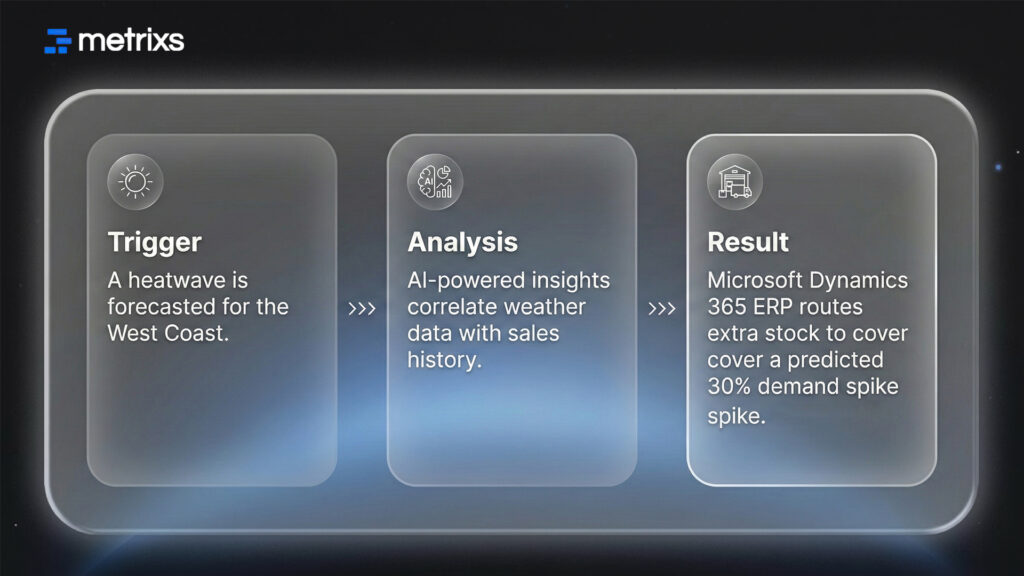
Effective inventory management relies on these AI-powered insights. You keep customers happy without overstocking. This capability defines modern Supply Chain Management.
Benefit #4. Real-Time Operational Visibility
You need to track products from the factory to the door. Microsoft Dynamics 365 ERP provides a unified view.
- IoT Connection: Sensors on machines report health data instantly.
- Predictive Maintenance: The system schedules repairs before breakdowns occur.
- Tracking: You spot bottlenecks immediately.
This visibility drives operational efficiency. You solve problems before they escalate. Real-time analytics keep your logistics moving smoothly. The analytics benefits extend to your workforce as well.
Human Resources: Optimizing Your Workforce
Your workforce drives your success. Microsoft Dynamics 365 ERP ensures you manage them effectively. You need tools that go beyond basic administrative tasks.
Benefit #5. Turning Employee Data into Retention Strategies
HR involves more than just payroll. You need to understand your people. The Human Resources module analyzes performance trends deeply. AI-powered insights spot patterns that suggest an employee might leave.
You identify high performers at risk early. This data helps you intervene with retention plans before a resignation letter arrives. You make data-driven decisions about your team structure to keep talent engaged.
Benefit #6. Self-Service Efficiency
Paperwork slows everyone down. Microsoft Dynamics 365 ERP solves this with self-service portals. Employees manage their own profiles and leave requests. This capability reduces administrative work significantly.
Your HR staff focuses on talent acquisition instead of data entry. These productivity improvements strengthen your entire organization. The system proves that analytics benefits apply to people, not just finances.
Next, we explore how to bridge the gap between this complex data and easy reporting.
How Metrixs Can Help You Maximize Dynamics 365 ERP Value
Reporting often creates a bottleneck. Metrixs delivers the world’s most advanced insights specifically for finance & operations. It helps you consolidate data seamlessly. You transform raw numbers into a unified view of Microsoft Dynamics 365 ERP performance across finance, inventory, and operations.
With a library of 1,000+ metrics and 100+ pre-built reports, Metrixs enables 80% faster reporting and 99.9% data accuracy. It eliminates manual inconsistencies and siloed data. Your Microsoft Dynamics 365 ERP serves as a growth engine rather than just a data collector.
Key Strengths:
- Rapid Integration: Get up and running in under six weeks. This seamless implementation minimizes business disruption.
- On-Demand Data Snapshots: Instantly capture historical trends and inventory flows. You gain proactive analytics benefits for better decision-making.
- Multi-Region Flexibility: Track multiple currencies and units effortlessly to ensure consistent reporting across global locations.
- Centralized Financial Oversight: Automate balance sheets to reduce manual work. You maintain a real-time view of all ERP modules.
- Measurable Impact: Smart insights help reduce operational costs by 15%. You optimize resource allocation within your Microsoft Dynamics 365 ERP strategy.
Metrixs turn data into a competitive advantage. You get the clarity and speed needed to scale efficiently. Explore how Metrixs ensures you use your system to its full advantage.
Conclusion
Microsoft Dynamics 365 ERP connects your enterprise, but managing its complex ERP modules often proves difficult. Native reporting tools frequently require technical maneuvering.
This complexity creates a dangerous blind spot. If you rely on inaccurate manual exports, you risk making critical errors in judgment. You operate with uncertainty while the market shifts. That data gap costs you profit.
Metrixs solves this problem by simplifying your financial reporting and operational data. We provide the clarity required to maximize your analytics benefits. You transform raw confusion into clear, actionable intelligence.
Ready to trust your numbers? Turn your ERP data into clear answers with Metrixs today.
FAQs
1. What is the primary benefit of Dynamics 365 ERP over legacy systems?
Legacy systems trap data in silos. Microsoft Dynamics 365 ERP unifies everything through the Dataverse for real-time analytics. You get automated workflows across finance and operations. This integration drives operational efficiency and helps you make data-driven decisions instantly, unlike static software.
2. How does the Supply Chain module improve inventory management?
The Supply Chain Management module uses AI-powered insights for accurate demand forecasting. It analyzes historical trends and market conditions to recommend optimal inventory management levels. You reduce storage costs and waste. This smart approach ensures you meet customer demand without tying up cash.
3. Can I implement modules one at a time?
Yes, flexibility defines cloud ERP. You can start with Finance and Operations to organize your books. Later, you add Human Resources or other ERP modules as you scale. Microsoft Dynamics 365 ERP grows with your business needs, ensuring you only pay for what you use.
4. Does Dynamics 365 include business intelligence tools?
Absolutely. The system integrates natively with Microsoft Power BI. You access rich visualizations and business intelligence directly within your dashboards. This embedded view allows you to monitor productivity improvements and key metrics without leaving Microsoft Dynamics 365 ERP, keeping your workflow uninterrupted and efficient.
5. How does AI improve financial reporting?
AI shifts you from reactive data to predictive action. AI-powered insights analyze customer behavior to forecast cash flow accurately. You manage liquidity proactively. Microsoft Dynamics 365 ERP transforms standard financial reporting into a strategic tool, giving finance teams the foresight needed to secure profitability.

