


Sales teams have more data than ever. Yet, 93% of organizations still fail at accurate revenue forecasting. Accessing information isn’t the issue. Interpreting the noise is where teams struggle. Without proper tools, managers rely on “gut feeling” instead of facts. Such behavior causes missed targets and wasted resources.
Microsoft CRM Dynamics fixes this gap between raw numbers and actionable strategy. Companies using AI-driven sales analytics are 83% more likely to exceed their goals. We will explore how Microsoft CRM Dynamics turns disconnected spreadsheets into a predictive engine. You can stop guessing and start growing.
The Hidden Cost of Gut-Feeling Sales Management
Traditional data management fails modern teams. Relying on manual spreadsheets results in forecast errors 15–20% higher than teams using intelligence platforms. You lose revenue. Microsoft CRM Dynamics addresses this by eliminating reliance on intuition.
Three core blind spots plague sales organizations:
- 1. Data Decay: Research shows 30% of contact records go bad annually. Teams waste time chasing “ghosts” without fresh customer data insights.
- 2. Pipeline Opacity: Managers can’t see bottlenecks until the quarter ends. You can’t fix sales pipeline management issues if you can’t see them.
- 3. Bias: Human optimism skews revenue forecasting. Reps often mark deals as “Committed” based on a feeling rather than data-driven decisions.
These blind spots destroy reliability, causing low conversion rates and misallocated budgets. You need a system that lights up the dark corners of your pipeline to solve this.
How Microsoft CRM Dynamics Revolutionizes Pipeline Visibility
You cannot fix what you cannot see. Most teams struggle because their data sits in static rows. Microsoft CRM Dynamics changes this by turning your pipeline into a living view of your business.
It moves beyond simple storage to active intelligence. This shifts focus from recording history to shaping the future.
A) From Static Data to Predictive Intelligence
Static dashboards report old news. Microsoft CRM Dynamics offers real-time deal pipeline visibility. The system analyzes deal age, rep activity, and engagement signals. It answers the critical question: “Which deals will actually close?“
CRM analytics remove optimism bias. Forecast accuracy jumps from 60% to over 90%. Leadership can report to stakeholders with confidence. You rely on behavioral data, not just rep intuition. Once you see the pipeline clearly, you need to know which specific leads deserve your attention.
B) Automated Lead Scoring (Stop Wasting Time)
Predictive lead scoring evaluates behavioral signals like clicks and downloads. Microsoft CRM Dynamics combines this with firmographics to rank every lead.Reps stop calling unqualified leads. They focus on buyers showing sales process automation signals. Companies using this feature see a 10–20% improvement in conversion rates.
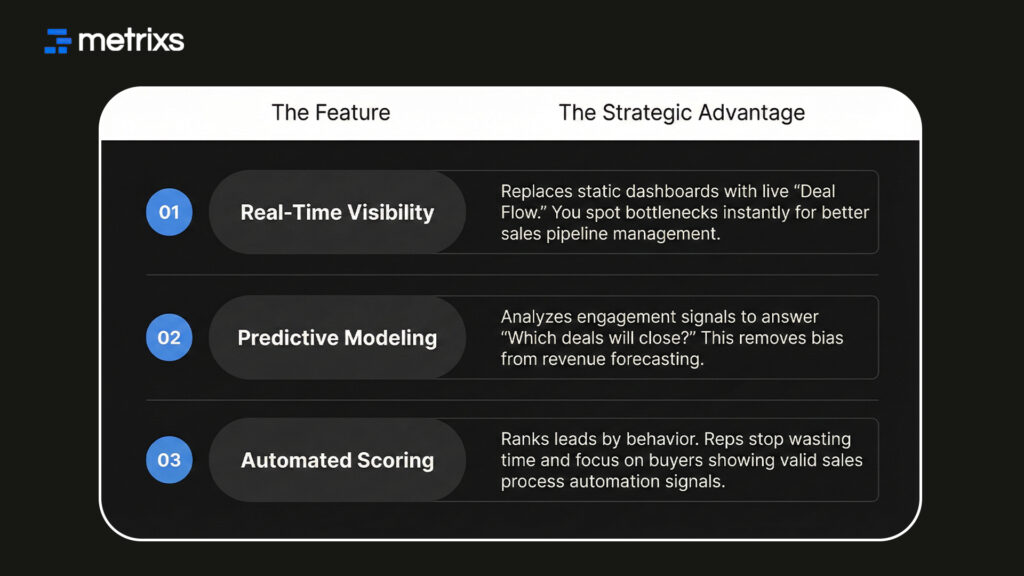
The model learns from every closed deal, getting smarter over time. Better leads improve the pipeline, but accurate financial planning requires deeper AI analysis.
Mastering Revenue Forecasting with AI
Moving numbers from a spreadsheet to a bank account requires precision. Microsoft CRM Dynamics uses advanced algorithms to predict outcomes. It replaces gut instinct with mathematical probability.
1. Precision Over Guesswork
Microsoft CRM Dynamics analyzes sales velocity, seasonal patterns, and historical team performance simultaneously. This shifts revenue forecasting from a “monthly guess” to a data-backed science.
The system delivers clarity through three key mechanisms:
- Pattern Recognition: AI identifies trends in your data that humans miss, such as seasonal dips or specific product cycles.
- Snapshotting: You can freeze the forecast at different points. This allows you to compare your pipeline today against the start of the quarter to see what changed.
- Strategic Planning: Leadership plans, hiring, and budgets with confidence. You eliminate quarterly surprises using data-driven decisions.
The AI warns you weeks in advance if you are trending to miss quota. Predicting the number is half the battle; ensuring your team has the skills to hit that number is the other half.
2. Real-Time Coaching via Conversation Intelligence
Performance metrics are derived from analyzing call recordings and emails. The system tracks sentiment and objection patterns. Managers identify exactly where a pitch fails. You provide specific coaching rather than generic advice.
This tool boosts sales productivity by identifying “talk-to-listen” ratios. New hires ramp up faster. They learn from the best practice libraries of top performers. Microsoft CRM Dynamics turns every call into a learning moment. Stronger individual performance is vital, but you also need to break down the walls between departments to see the full picture.
Breaking Silos: The 360-Degree Customer View
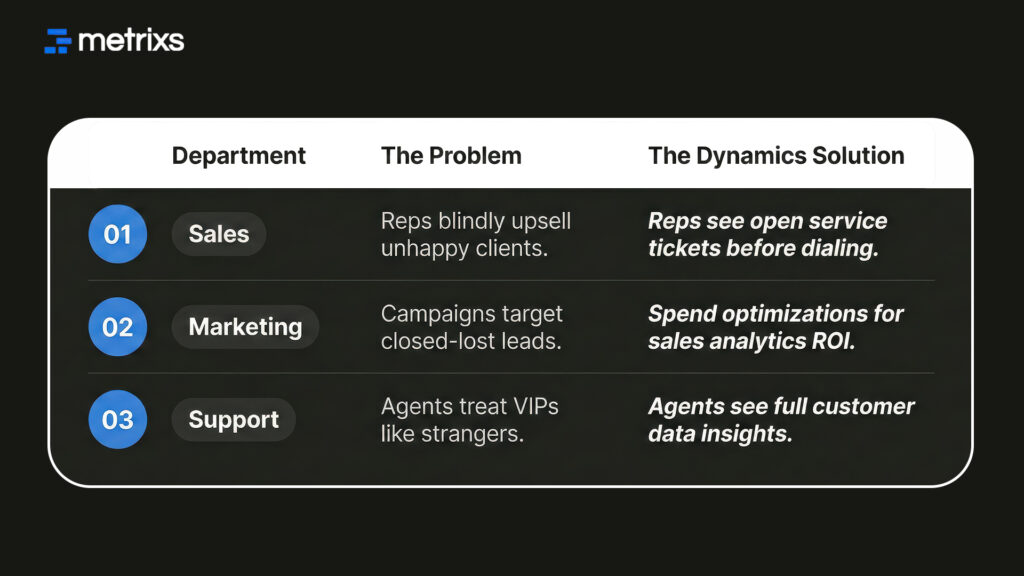
Sales, marketing, and support often operate in parallel worlds. This creates disjointed experiences. Microsoft CRM Dynamics solves this by creating a unified system. It connects every touchpoint into a single source of truth.
Microsoft CRM Dynamics unifies your data to drive revenue:
For Example:
Imagine a sales rep is about to call a key account to renew a contract. Without Microsoft CRM Dynamics, they don’t know the client logged a critical severity-1 bug two hours ago. The rep calls, asks for money, and the client explodes. The deal is lost.
With deal pipeline visibility integrated with support data, the rep sees the red flag immediately. Instead of pitching, they call to offer assistance with the bug. This saves the relationship.
Organizations with unified data see 23% higher customer lifetime value. Win rates increase by 25%. You break down walls between departments. This alignment sets the stage for advanced implementation strategies.
Unlocking the Full Potential of Dynamics Analytics with Metrixs
Metrixs delivers the world’s most advanced analytics and reporting insights. It helps enterprises consolidate data seamlessly, transforming raw numbers into a unified view of Microsoft CRM Dynamics performance across finance, inventory, and operations.
With a comprehensive library of 1,000+ metrics and 100+ pre-built reports, Metrixs enables 80% faster sales analytics reporting and 99.9% data accuracy. It eliminates manual inconsistencies and siloed data, ensuring your ERP and CRM serve as a growth engine rather than just a data collector.
Key Strengths:
- Rapid Integration: Get up and running in under six weeks with a seamless Microsoft CRM Dynamics implementation that minimizes business disruption.
- On-Demand Data Snapshots: Instantly capture historical trends, workforce shifts, and inventory flows for proactive data-driven decisions.
- Multi-Region Flexibility: Effortlessly track multiple currencies and units of measurement to ensure consistent sales analytics reporting across global locations.
- Centralized Financial Oversight: Automate balance sheets and financial summaries to reduce manual work and maintain a real-time view of revenue forecasting.
- Measurable Impact: Smart insights help reduce operational costs by 15% and optimize resource allocation within your Microsoft CRM Dynamics strategy.
Metrixs turn data into a competitive advantage, providing the clarity and speed businesses need to scale efficiently.
Unlock the full power of your data and maximize ROI with Metrixs.
Conclusion
Microsoft CRM Dynamics offers the power to turn raw numbers into accurate revenue forecasting. Yet, simply buying the license doesn’t guarantee results. Native dashboards often feel complex, and without precise configuration, the data becomes noisy and hard to interpret.
If you get the implementation wrong, you risk more than just wasted software fees. You risk making high-stakes strategic decisions based on flawed numbers. This creates a “trust gap” where teams abandon the system and revert to spreadsheets.
Metrixs prevents this failure. We align sales analytics specifically to your operational reality, ensuring your data is clean, accessible, and actually useful. We turn complexity into clarity so you can scale with confidence.Ready to trust your numbers? Contact Metrixs today to audit your sales analytics maturity.
FAQs
1. How quickly will we see improvements in forecast accuracy?
Most teams see forecast accuracy jump significantly within 3–6 months. Microsoft CRM Dynamics requires time to analyze historical trends. Once the AI-powered forecasting learns your patterns, you unlock reliable data-driven decisions. This eliminates guesswork and rapidly stabilizes your sales pipeline management for better results.
2. Does predictive lead scoring replace the sales rep’s judgment?
No, it empowers them. Predictive lead scoring handles the complex math by analyzing thousands of data points. This boosts sales team performance by ensuring reps focus on high-intent prospects. You improve conversion rates while reps use their judgment and customer insights to close deals effectively.
3. Can Microsoft Dynamics CRM integrate with our existing tools?
Yes, it integrates natively with Outlook and Teams. Microsoft CRM Dynamics connects easily with third-party apps to maintain high sales productivity. This seamless connectivity supports sales process automation, allowing your team to access vital CRM analytics without ever leaving their familiar workflow or switching tabs.
4. What if our current data is messy?
You don’t need perfection to start. Microsoft CRM Dynamics helps identify and clean dirty data. We recommend focusing on core fields first to generate usable customer data insights. As you refine the system, your sales analytics improve, providing clearer deal pipeline visibility and accuracy over time.
5. Is this solution scalable for growing teams?
Absolutely. Microsoft CRM Dynamics scales from 20 to 5,000 users without breaking. It supports increasing sales velocity as you expand. The more data you feed it, the smarter your revenue forecasting becomes. It tracks evolving performance metrics, ensuring your system grows alongside your business requirements.

