

Your ERP reports often lie to you. Poor master data governance breaks your analytics. Gartner finds bad data costs firms millions. Most leaders blame software. Actually, master data governance fixes these gaps.
You need a solid data governance framework to stop the bleeding. Without it, data integrity disappears and ruins your ERP reporting accuracy. Modern master data management creates a single source of truth.
Clean data leads to better decisions. Stop guessing. Trust your numbers. Better data keeps your business running fast and helps your team stay productive.
What Master Data Governance Actually Controls in an ERP System
You might think your software just needs a new plugin to fix report errors. It doesn’t. Your ERP is a giant engine that runs on data. If the fuel is dirty, the engine stalls.
Master data governance is the filter that keeps that fuel clean. It defines who owns the data and what rules it must follow before it enters your system.
1. The “Golden Record” Problem No One Talks About
Every part of your ERP, finance, sales, and supply chain uses the same core files. These are your enterprise data assets. When you lack a data governance framework, each department creates its own version of a “customer” or “vendor.”
This creates a mess. Finance might see a vendor as “Acme Corp,” while procurement sees “Acme LLC.” Master data management solves this by creating a golden record.
This is the one authoritative version of a record that every module uses. It stops inconsistencies before they start and ensures data consistency across your entire platform.
2. What Breaks First When Governance Is Missing
Data duplication is the first sign of trouble. If you have three entries for the same part, your inventory reports will show stock you don’t actually have. This “phantom inventory” ties up cash. Poor data stewardship also ruins procurement.
If your supplier data is a mess, you can’t see your total spend. This makes it impossible to negotiate better deals. In a large warehouse, a tiny error rate in your master data management can lead to millions in wasted stock.
Key ERP Domains At a glance:
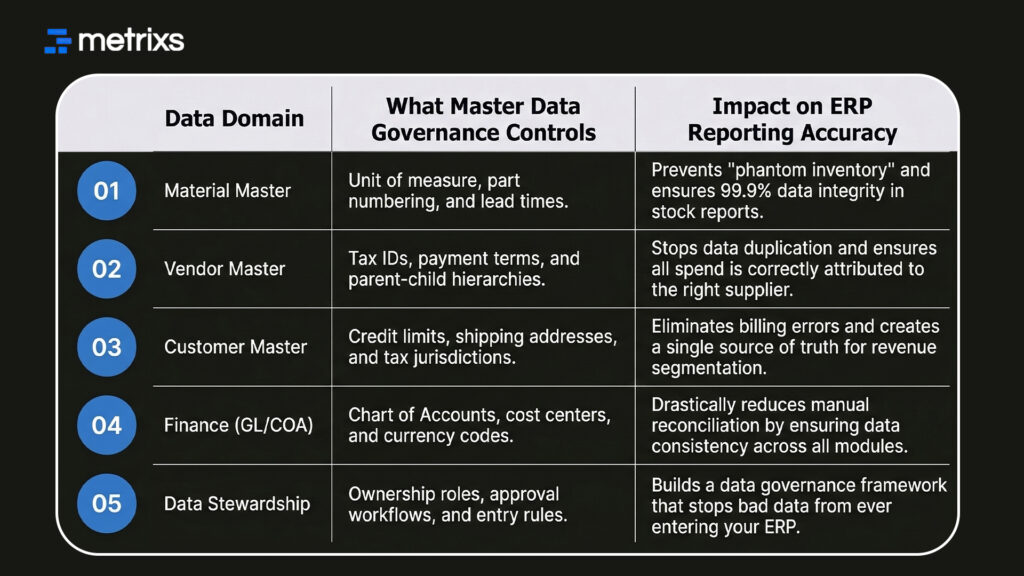
When you control these core records, your system finally works the way it should.
How Poor Master Data Governance Corrupts ERP Reporting (The Real Damage)
Many blogs ignore the true cost of bad data, but your bottom line feels it every day. Errors don’t just stay in one spreadsheet; they spread throughout your system. Poor master data governance acts like a slow leak that eventually floods your entire operation.
1. Silent Reporting Errors That Hide in Plain Sight
Most errors in your ERP aren’t bugs. They are governance failures. You know there is a problem when your finance team spends days in Excel just to make the numbers match. Proper master data management fixes this.
- Manual Reconciliation: Without a single source of truth, your team manually fixes records instead of analyzing data. Centralized governance reduces this wasted effort by nearly 40%.
- Phantom Inventory: Data duplication creates material records that don’t exist in the real world. You think you have stock, but the shelf is empty.
- Misattributed Spend: If one vendor has five different names in your system, you can’t see your total purchasing power. This hurts ERP reporting accuracy and your ability to save money.
2. Compliance Reporting Gets Hit Hardest
Regulators don’t care about your software bugs. They care about data integrity. If your master data management is messy, your audit trails will be incomplete. Many companies keep data in over 10 different systems. Without a unified data governance framework, each system becomes a legal risk during an audit.
Automating your master data governance reduces the effort needed for compliance by a quarter. It ensures that every record, from customer tax IDs to supplier certifications, is valid and traceable. This protects your brand and your bank account from heavy fines.
When your data is broken, your reports are just guesses. Fixing this requires a clear structure for how your team handles every record.
How a Data Governance Framework Actually Gets Built Inside ERP
Building a data governance framework isn’t a one-time project. It is a shift in how your business handles its most valuable asset: enterprise data.
To get your ERP reporting accuracy back on track, you must move from reactive cleaning to proactive control using master data governance.
1. Roles, Rules, and Workflow Automation
A successful MDM implementation relies on people, not just code. You need clear data stewardship. This means assigning owners to specific data sets, like customer or vendor records. These owners ensure every new entry meets your quality standards before it ever hits the live system.
Workflow automation handles the heavy lifting. Instead of emails and spreadsheets, use automated requests for data changes. This process maintains data integrity by using validation rules that block bad info automatically.
Automation can cut your data management time by up to 46%. It ensures your master data management stays lean and your records stay clean.
2. Multi-Domain Governance vs. Single-Domain Setups
Many companies start by fixing just one area, like their vendor list. While that helps, true data consistency requires a multi-domain approach. If your customer data is clean but your product data is a mess, your ERP reporting accuracy will still suffer.
- Better Data Reuse: Connecting domains allows you to reuse enterprise data across your CRM and ERP, increasing efficiency by 26%.
- Reduced Fragmentation: A multi-domain master data governance strategy prevents “data islands” where departments contradict each other.
- Faster Financial Close: When customer and material records align, your finance team spends less time fixing errors.
- Scalability: Managing millions of records in your master data management system requires a strategy that grows with you.
Connecting these domains creates a single source of truth that serves your entire company. This shift turns your ERP into a high-speed engine for growth.
How Metrixs Enforces Master Data Standards Across Every ERP Report
Metrixs offers the most advanced analytics for Microsoft Dynamics 365 Finance & Operations. It helps you consolidate enterprise data and transform raw numbers into a unified view of master data governance performance.
With 1,000+ metrics, Metrixs enables 80% faster reporting and 99.9% ERP reporting accuracy.
- Rapid Integration: Launch your master data governance strategy in under six weeks.
- On-Demand Snapshots: Capture historical trends for proactive ERP reporting accuracy decisions.
- Multi-Region Flexibility: Track global locations while maintaining a single source of truth.
- Financial Oversight: Automate summaries to reduce manual work and maintain data integrity.
- Measurable Impact: Reduce operational costs by 15% within your data governance framework.
Metrixs turn data into a competitive advantage. Explore Metrixs today to simplify your master data management.
Conclusion
Your ERP system is only as reliable as the master data governance policies fueling it. Without a strict data governance framework, your enterprise data becomes a liability. You face the constant threat of data duplication and “phantom inventory” that quietly drains your capital.
These errors trigger failed audits, skewed profit margins, and costly compliance penalties. Relying on flawed ERP reporting accuracy in 2026 is a gamble that risks your reputation.
Metrixs eliminates this uncertainty by enforcing a single source of truth and automating data stewardship, ensuring your master data management remains flawless.
Stop guessing and start leading with 99.9% ERP reporting accuracy—let Metrixs transform your master data governance today.
FAQs
1. What is master data governance in an ERP context?
Master data governance is the set of rules and roles controlling how core records like customers and products enter your system. It ensures data integrity by using a data governance framework to stop errors. This process maintains a single source of truth across your ERP.
2. How does poor master data governance affect ERP reporting accuracy?
Without master data governance, inconsistent records create “phantom inventory” and misattributed spending. These errors ruin your ERP reporting accuracy, forcing teams into manual reconciliations. Proper master data management eliminates these gaps, ensuring your enterprise data remains reliable and your financial reports stay 99.9% accurate.
3. What is a data governance framework, and why does ERP need one?
A data governance framework defines who owns specific data and sets validation rules. It prevents data duplication and maintains data consistency across modules. This structure is essential for master data management, as it ensures every department pulls from the same single source of truth.
4. How long does it take to implement master data governance for an ERP?
A full MDM implementation usually takes months, but tools like Metrixs offer rapid integration in under six weeks. This fast-track master data governance approach delivers measurable ERP reporting accuracy improvements quickly. It turns your messy enterprise data into a streamlined engine for business growth.
5. What is the difference between master data management and master data governance?
Master data governance is the strategy and rulebook for your data. Master data management is the technical execution that cleans and merges records. Both are required to maintain data integrity and ensure your ERP reporting accuracy remains high through 2026 and beyond.

