

Stop making decisions with stale data. Manual processes force your team to spend 10 days on journal entries and account reconciliation. Using financial close software reduces your close cycle time by 50 percent.
Many CFOs now invest in month-end close automation to fix late insights. This financial close software speeds up your record to report workflow. Effective financial close management removes approval bottlenecks.
You can achieve 95% journal entry automation and finish your reports faster. Here is how modern tools deliver these results.
What’s actually making the financial close slow?
Manual workflows fail because they cannot handle the volume of modern data. Your team wastes hours on repetitive tasks that don’t add value. Here are the specific bottlenecks that stall your financial close management.
1. The manual reconciliation backlog at period-end
Account reconciliation consumes the largest share of your time. Matching general ledger balances against source documents one by one is a recipe for delay.
- Late exceptions: Errors surface too late in the close cycle time to fix them easily.
- High manual effort: Senior staff spends hours on basic matching instead of analysis.
Financial close software with automated matching flags true errors instantly, shrinking your window from days to hours.
2. Disconnected approval chains that stall journal entries
Journal entries often die in email threads. When a sign-off stalls, every downstream task stops too. Journal entry automation routes these to the right person immediately. It triggers reminders and gives you a live view of the record to report the process so nothing gets stuck.
3. No real-time visibility into close progress
Without a centralized, close checklist, you spend time chasing updates instead of fixing problems. Financial close software provides dashboards for better close task management. You see every bottleneck as it happens, keeping your close cycle time on track.
These manual habits keep your financial close software from reaching its full potential. You must identify where the human element creates a backlog to improve your speed.
Fixing these issues is easier when you understand the specific mechanics that drive month-end close automation.
How financial close software specifically shortens reporting cycles
Speed up your reporting by changing how you handle your data. Financial close software uses three main tools to cut your close cycle time by half. Proper financial close management stops the month-end panic through month-end close automation. Using high-quality financial close software makes your life easier.
1. Continuous accounting vs. period-end processing
Traditional methods save all the work for the last week. Using financial close software allows you to spread tasks throughout the month.
- Perform your account reconciliation daily to catch errors early.
- Use journal entry automation to post recurring adjustments instantly.
- Speed up your financial consolidation by keeping entity data current.
By the time Day 1 arrives, most of your work is already done.
2. ERP integration that eliminates manual data extraction
Direct ERP integration pulls data in real-time. This removes the need for manual CSV exports that lead to formatting errors or broken links.
- Live data stream: Your close checklist updates instantly with actual ledger figures.
- Audit trail: Every data pull creates a clear audit trail for future reviews.
Consistent data flow ensures your record to report process remains accurate without manual intervention.
3. AI-driven variance analysis that replaces manual flux reviews
Stop writing manual explanations for every minor change. Modern financial close software uses AI to handle your variance analysis.
- Improve your close task management by flagging only major anomalies.
- Shorten the entire record to report the path with automated commentary.
These features turn your slow month-end into a fast, automated process. Next, you should choose the right tool for your specific needs.
Top 5 financial close software in 2026
Selecting the right financial close software depends on your ERP and team size. Here are the top platforms delivering the best financial close management results in 2026.
1. Metrixs (best for Microsoft Dynamics 365 Finance & Operations)
Metrixs provides a specialized environment for Dynamics 365 users to automate their record-to-report workflow. It bridges the gap between raw ERP data and audit-ready financial statements without complex coding.
Features:
- Accelerates reporting by 80 percent using a library of 1,000+ pre-built metrics.
- Ensures 99.9 percent data accuracy through seamless ERP integration and automated data snapshots.
- Delivers multi-region flexibility to track various currencies and units across global locations.
- Deploys in under six weeks to quickly improve your close cycle time.
Best for: Global enterprise teams on Dynamics 365 seeking rapid month-end close automation and real-time financial oversight without custom development
2. BlackLine
BlackLine is a premier financial close software built for large-scale financial close management. It excels at unifying complex data from multiple entities while maintaining strict compliance with global accounting standards.
Key Features:
- Centralizes account reconciliation and transaction matching with automated AI-driven rules.
- Provides an end-to-end audit trail that ensures SOX and IFRS compliance for public companies.
- Offers a specialized Intercompany Hub to resolve entity imbalances and simplify financial consolidation.
Best for: Global enterprises with complex entity structures and high-volume transactions requiring a rigorous, audit-ready environment.
3. FloQast
FloQast delivers intuitive financial close software built by accountants. It focuses on team collaboration and uses a checklist-driven approach to simplify your financial close management and account reconciliation.
Key Features:
- Connects directly to your Excel workbooks to maintain your current record to report workflows.
- Includes a centralized close checklist that syncs with your ERP for real-time progress tracking.
- Uses AI-powered matching to speed up account reconciliation and catch discrepancies instantly.
Best for: Mid-sized companies that want a user-friendly tool to start their month-end close automation journey without a heavy IT lift.
4. Trintech Cadency
Trintech Cadency is a highly configurable financial close software designed for large-scale global enterprises. It unifies account reconciliation, journal entries, and compliance into a single risk-intelligent platform for complex financial close management.
Key Features:
- Uses AI-driven risk ratings to prioritize high-risk items in your close checklist.
- Automates 90% of transaction matching and journal entry automation through ERP-agnostic connectors.
- Provides real-time variance analysis and a generative AI assistant for contextual accounting guidance.
- Centralizes all documentation in an audit-ready “eBinder” for a seamless audit trail.
Best for: Global companies with multiple ERP systems needing highly configurable, risk-based month-end close automation.
5. HighRadius
HighRadius provides an AI-driven Record to Report suite as part of its autonomous finance platform. It uses financial close software to automate manual accounting tasks and provide real-time visibility into your close cycle time.
Key Features:
- Uses AI-powered engines to automate account reconciliation and intercompany accounting tasks.
- Delivers automated variance analysis with zero-touch anomaly detection for faster reporting.
- Connects via direct ERP integration to ingest data without manual exports or flat files.
- Provides a live dashboard for close task management to track progress across global teams.
Best for: Mid-to-large enterprises seeking an “autonomous” approach to month-end close automation and advanced AI-driven insights.
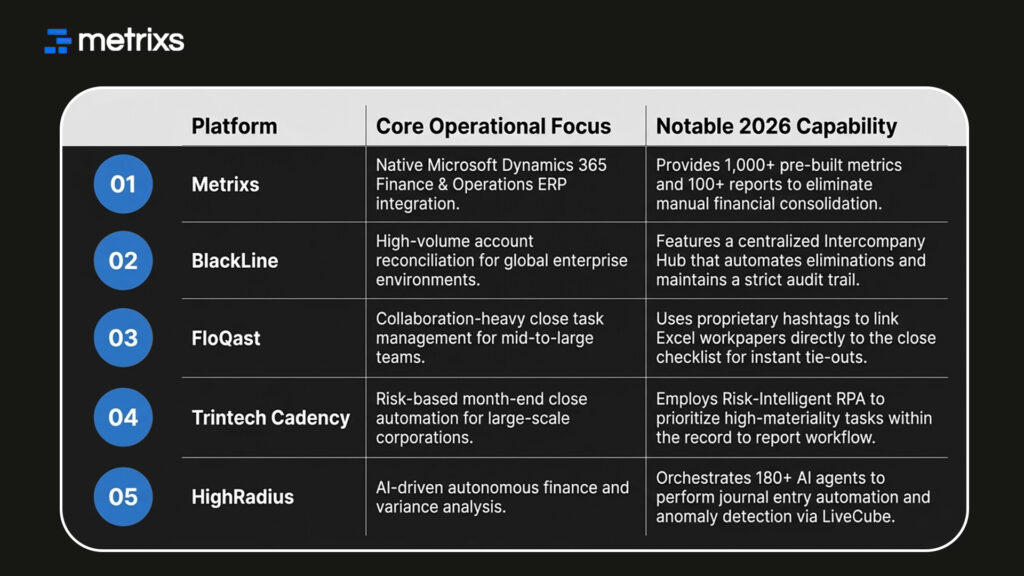
Financial close software platforms at a glance:
Conclusion
Manual financial close software workflows delay your reporting by weeks. Your team drowns in account reconciliation and outdated close checklist files. One missed journal entry automation step leads to material errors that destroy your credibility. These delays cause failed audits and expensive data mistakes. Poor financial close management is a risk you cannot afford.
Metrixs solves this by using financial close software to fix your month-end close automation tasks. You achieve a faster close cycle time and 99 percent accuracy without the usual implementation headaches or manual data entry.
Stop losing days to manual cycles and switch to financial close software that delivers a 3-day close with Metrixs.
FAQs
1. What is financial close software, and what does it automate?
Financial close software automates account reconciliation, journal entries, and financial consolidation. It creates a digital close checklist and audit trail, replacing manual spreadsheets. Using month-end close automation for close task management ensures your record-to-report process stays accurate and fast.
2. How much does financial close software reduce close cycle time?
Most teams cut their close cycle time by 30–50 percent. By implementing financial close software, you shift from 10-day cycles to a 3-day close. Financial close management tools eliminate bottlenecks in account reconciliation and journal entry automation for faster results.
3. What is the difference between financial close software and ERP financial reporting?
ERPs record transactions, but financial close software manages the verification process. While ERPs provide data, financial close management tools handle account reconciliation, approvals, and variance analysis. This software adds a layer of month-end close automation that standard ERPs lack.
4. What features should financial close management software include?
Look for ERP integration, automated account reconciliation, and a real-time close checklist. Top-tier financial close software must include journal entry automation, a transparent audit trail, and AI-driven variance analysis to handle complex financial consolidation and record-to-report workflows effectively.
5. What is continuous accounting and how does it shorten the financial close?
Continuous accounting spreads account reconciliation and tasks throughout the month. Instead of a month-end sprint, financial close software performs daily matching. This month-end close automation reduces the workload at period-end, significantly shrinking your overall close cycle time and reporting lag.
6. Is financial close software suitable for Microsoft Dynamics 365 environments?
Yes, especially with Metrixs. This financial close software is purpose-built for Dynamics 365, offering 1,000+ pre-built metrics. It enables rapid month-end close automation and financial consolidation, ensuring 99.9 percent accuracy for your record-to-report cycle without custom coding.

