


Big companies often treat pipeline failures like simple data problems. Today, the market for ETL tools enterprise teams buy is worth $8.85 billion. Yet, teams still deal with 67 broken pipelines every month.
These errors hurt data quality and cost millions. You can stop this waste. Modern scalable ETL software reduces your build time by 80%. Since 72% of leaders need a real-time data pipeline, you need better enterprise data pipeline tools.
This guide helps you pick the right ETL enterprise tools for your data warehouse.
7 ETL Tools Enterprise Teams Use for Scalable Analytics in 2026
Selecting the right ETL tools enterprise teams rely on requires looking past marketing hype. You need a data integration platform that handles extract, transform, and load tasks without manual coding.
Quick Comparison: Top 7 ETL Tools for Enterprise Scale in 2026:
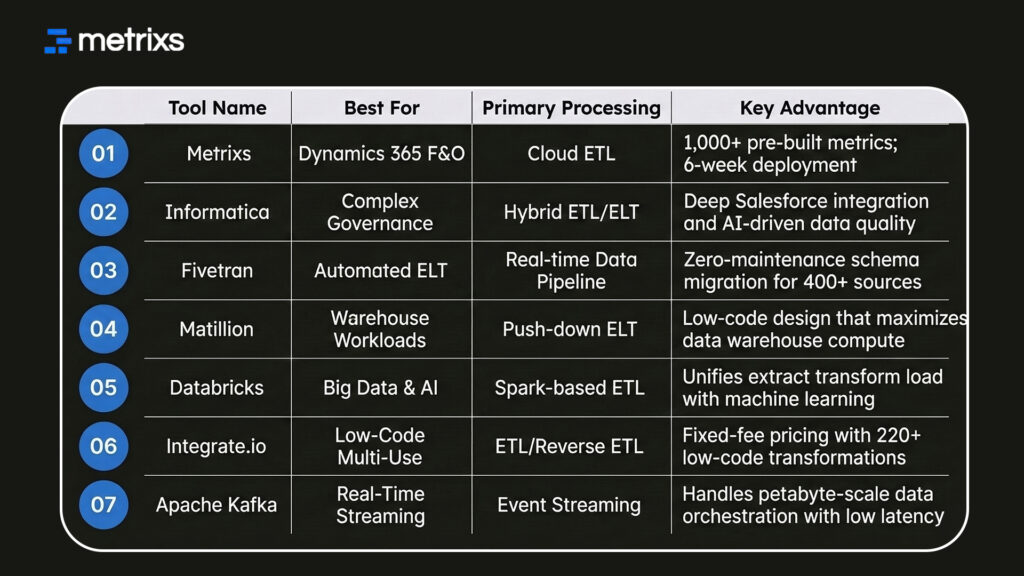
These seven enterprise data pipeline tools offer the best scalable ETL software solutions for 2026.
1. Metrixs: Best for Microsoft Dynamics 365 F&O Analytics
Metrixs transforms how you handle complex ERP data. It functions as a specialized cloud ETL layer that turns raw Dynamics 365 info into actionable insights instantly. You get a real-time data pipeline that skips the traditional, slow build phase and delivers high-speed results.
Key Features:
- Automates extract, transform, and load processes for 1,000+ financial and operational metrics.
- Maintains 99.9% accuracy with pre-built data quality checks.
- Executes a full data integration platform setup in under six weeks.
- Handles schema migration automatically to keep reports current.
Why Choose Metrixs: Choose Metrixs to stop building manual pipelines for Dynamics 365. It gives you an ETL tools enterprise solution that works right out of the box.
Industries Catered: Manufacturing, Retail, Global Finance, Supply Chain, Distribution.
Reviews: ⭐⭐⭐⭐⭐ (5/5 stars)
2. Informatica: Best for Complex Enterprise Governance
Informatica provides a robust data integration platform for huge corporations. It manages extract, transform, and load workflows across legacy systems and cloud ETL environments.
Since Salesforce bought it in late 2025, this ETL tool’s enterprise choice ensures your data warehouse stays connected to your CRM.
It is a top-tier scalable ETL software for companies needing ETL tools and enterprise reliability.
Key Features:
- Automates data orchestration and data quality checks using CLAIRE AI.
- Utilizes Change Data Capture to keep your real-time data pipeline accurate.
- Simplifies schema migration across multi-cloud and on-premises setups.
- Integrates with enterprise data pipeline tools through thousands of native connectors.
Why Choose Informatica: It is the gold standard for high-security environments. Use this ETL tool’s enterprise software if you need total control over complex data governance.
Industries Catered: Finance, Healthcare, Retail, Public Sector, Manufacturing.
Reviews: ⭐⭐⭐⭐ (4.5/5 stars)
3. Fivetran: Best for Automated ELT With Minimal Maintenance
Fivetran simplifies your data warehouse loading by treating every real-time data pipeline as a utility. It automates the exact transform load cycle without requiring manual scripts or maintenance.
This cloud ETL tool is the gold standard for teams that want reliable enterprise data pipeline tools with zero configuration.
Key Features:
- Detects and manages schema migration automatically to prevent downstream breaks.
- Supports Change Data Capture to keep your data warehouse synced in minutes.
- Offers 400+ native connectors for a truly scalable ETL software experience.
- Integrates data quality checks to ensure your analytics stay accurate and clean.
Why Choose Fivetran: Choose Fivetran if you want to stop fixing broken pipelines. This ETL tool, an enterprise favorite, lets your engineers focus on analysis rather than maintenance.
Industries Catered: SaaS, E-commerce, Marketing Agencies, Financial Services, Modern Tech.
Reviews: ⭐⭐⭐⭐ (4.7/5 stars)
4. Matillion: Best for Cloud Data Warehouse Workloads
Matillion operates as a powerful cloud ETL platform that maximizes your existing infrastructure. It pushes all extract, transform, and load logic directly into your data warehouse for maximum efficiency. This scalable ETL software provides a visual interface that makes complex data orchestration accessible to every engineer.
Key Features:
- Uses a high-speed real-time data pipeline to sync data into Snowflake and BigQuery.
- Provides low-code and no-code components for rapid data integration platform builds.
- Automates schema migration to handle changing source systems without downtime.
- Includes built-in data quality tools to validate your enterprise data pipeline tools’ output.
Why Choose Matillion: Choose Matillion to lower your computer costs. This ETL tool’s enterprise option uses your warehouse’s power to run transformations faster than traditional tools.
Industries Catered: Finance, E-commerce, Healthcare, Information Technology, Logistics.
Reviews: ⭐⭐⭐⭐ (4.5/5 stars)
5. Databricks: Best for Big Data ETL and AI/ML Integration
Databricks excels as a unified data integration platform for high-volume extract, transform, and load tasks. It uses a lakehouse architecture to merge your data warehouse and data lake into one space. This scalable ETL software is perfect for teams building advanced AI models alongside traditional analytics.
Key Features:
- Zerobus Ingest provides a serverless real-time data pipeline for instant streaming.
- Unity Catalog automates data orchestration and data quality monitoring across all assets.
- Delta Live Tables simplifies schema migration and handles Change Data Capture flawlessly.
- Supports diverse enterprise data pipeline tools with open standards like Spark and Delta Lake.
Why Choose Databricks: Choose Databricks if your enterprise ETL tool needs must support both massive scale and machine learning. It is the best cloud ETL choice for data science teams.
Industries Catered: Financial Services, Healthcare, Manufacturing, Retail, Media & Entertainment.
Reviews: ⭐⭐⭐⭐ (4.5/5 stars)
6. Integrate.io: Best for Low-Code Multi-Use ETL at Scale
Integrate.io acts as a Swiss Army knife for modern data teams needing to bridge the gap between warehouses and operational tools. Its low-code environment lets you build complex extract, transform, load workflows without writing a single line of Python or SQL code.
Key Features:
- Features a unified data integration platform that supports ETL, ELT, and reverse ETL in one interface.
- Delivers sub-60 second Change Data Capture to power your real-time data pipeline requirements.
- Provides 220+ pre-built transformations to maintain high data quality across all your source systems.
- Automates schema migration for 200+ native connectors, reducing the burden on your engineering team.
Why Choose Integrate? io: Choose Integrate.io for predictable budgeting. This ETL tool’s enterprise option uses fixed-fee pricing instead of charging you for every row of data you process.
Industries Catered: E-commerce, Retail, SaaS, Manufacturing, Financial Services, Healthcare.
Reviews: ⭐⭐⭐⭐ (4.3/5 stars)
7. Apache Kafka: Best for Real-Time Event Streaming at Petabyte Scale
Apache Kafka is the backbone of the modern real-time data pipeline. It processes trillions of messages daily for the world’s largest companies. This scalable ETL software serves as a high-throughput data integration platform that handles data at a massive scale.
Key Features:
- Supports sub-second latency for any real-time data pipeline or event-driven architecture.
- Decouples your extract-transform-load source systems from your target data warehouse.
- Uses a schema registry to automate schema migration and prevent data breaks.
- Enables high-performance Change Data Capture across distributed database systems.
Why Choose Apache Kafka: Choose Kafka if you need to process massive streams of data instantly. It is the ultimate ETL tool enterprise choice for high-frequency trading or live inventory.
Industries Catered: Finance, E-commerce, Gaming, Telecommunications, Logistics.
Reviews: ⭐⭐⭐⭐ (4.5/5 stars)
What Separates Enterprise ETL Tools From the Rest
Most ETL tools enterprise vendors sell look similar on paper. However, you quickly see the difference when your data volume jumps from gigabytes to terabytes. A basic tool works fine for a simple spreadsheet.
True scalable ETL software acts as a self-healing system for your data warehouse. It doesn’t just move data; it protects data quality and ensures your real-time data pipeline stays active even when source APIs change.
A) The Four Things Only Enterprise-Grade ETL Tools Handle Reliably
1. Automated Schema Management: These enterprise data pipeline tools detect when a developer adds a column or changes a data type at the source. Instead of crashing, the data integration platform adjusts the target table in your data warehouse automatically.
2. Unified Batch and Stream Processing: Modern business needs both. Your ETL tools’ enterprise setup must handle massive nightly historical loads and high-speed real-time data pipeline events simultaneously without doubling your infrastructure costs.
3. Native Change Data Capture (CDC): High-volume environments cannot afford full table scans. Top-tier scalable ETL software uses Change Data Capture to read database logs and only move the rows that changed since the last sync.
4. Built-in Governance and Lineage: Large companies need to know exactly where every piece of data came from to stay compliant. These tools provide immutable logs and visual maps showing the journey from extract, transform, and load to the final report.
B) What to Look for Before Choosing an Enterprise Data Pipeline Tool
1. Connector Resiliency: Don’t just count the number of connectors. Check if they handle API rate limits and pagination without manual tuning.
2. Logic Pushdown Capabilities: Efficient cloud ETL tools push the heavy lifting to your warehouse’s compute engine to save money and time.
3. Total Cost of Ownership: Look past the license fee. Factor in the cost of engineering hours spent fixing broken pipelines and the business cost of bad data quality.
Choosing a tool that ticks these boxes ensures your infrastructure grows with your company rather than becoming a bottleneck.
Why Enterprise Data Teams Always Choose Metrixs to Close the ETL Analytics Gap
Metrixs offers the most advanced data integration platform specifically for Microsoft Dynamics 365 Finance & Operations. It turns complex ERP data into a unified view of ETL tools’ enterprise performance.
You get 1,000+ metrics and 100+ reports that deliver 99.9% data quality and 80% faster scalable ETL software reporting.
- Rapid Integration: Launch your enterprise ETL tool setup in under six weeks.
- On-Demand Snapshots: Capture trends for better enterprise data pipeline tool decisions.
- Multi-Region Flexibility: Track global currencies through a consistent cloud ETL process.
- Financial Oversight: Automate summaries for a real-time data pipeline view.
Metrixs ensures your ERP acts as a growth engine for your ETL tools’ enterprise strategy. Explore Metrixs and unlock the full potential of your ETL tools enterprise strategy today.
Conclusion
Choosing from these seven ETL tools enterprise teams trust requires matching your data warehouse needs with the right data integration platform. While these enterprise data pipeline tools offer massive scale, they often bring hidden pain.
Managing a complex real-time data pipeline across 40+ sources frequently leads to constant breaks and 15-hour resolution windows.
If your scalable ETL software fails, your dashboards reflect last week’s errors, not today’s reality. This creates a dangerous “data drift” where finance and operations teams make million-dollar decisions based on broken numbers.
You don’t have to live with these pipeline failures. Metrixs solves these issues for Dynamics 365 by delivering a pre-built cloud ETL layer that guarantees data quality without the manual burden.
Let’s connect with Metrixs and see how you can automate your Dynamics 365 reporting today.
FAQs
1. What are ETL tools enterprise teams actually need?
Enterprise teams need a data integration platform that automates schema migration and supports Change Data Capture. These enterprise data pipeline tools must scale without manual coding to maintain data quality. Evaluate the total cost of ownership for your scalable ETL software before buying.
2. What is the difference between ETL and ELT for enterprise analytics?
Extract transform load (ETL) cleans data before loading. ELT loads raw data first, using data warehouse compute for transformations. Most cloud ETL users prefer ELT for speed. The best ETL tools enterprise teams use combine both for a real-time data pipeline.
3. How do enterprise ETL tools handle schema changes without breaking?
Top scalable ETL software uses schema registries to detect source changes instantly. The data integration platform updates your data warehouse tables automatically, preventing crashes. This automation is a vital feature of enterprise data pipeline tools to avoid the 67 monthly pipeline incidents.
4. What makes Metrixs different from general-purpose enterprise ETL tools?
Metrixs is a specialized data integration platform built for Microsoft Dynamics 365. Unlike general ETL tools and enterprise options, it includes 1,000+ metrics. It builds your real-time data pipeline in six weeks, offering 99.9% data quality that general scalable ETL software misses.
5. What is Change Data Capture, and why is it essential?
Change Data Capture (CDC) allows your data integration platform to replicate only changed rows. It is essential for a real-time data pipeline to avoid crashing source systems. Without CDC, scalable ETL software cannot keep a data warehouse updated at enterprise scale.

