

Unprepared companies often see their finances take a hit when managing ERP reporting. Research shows most projects go over budget by 189%. These ERP costs drain your resources if you don’t plan for the total cost of ownership.
You might think software is the only expense, but implementation expenses often eat up half your budget. Gartner predicts most ERP efforts will fail by 2027 due to these financial gaps. You need a clear breakdown of ERP reporting fees to protect your bottom line and avoid a disaster.
Picking the right way to buy your software changes your financial future. You need to understand how software licensing impacts your daily operations and your ERP reporting quality.
Software Licensing and Acquisition Costs for ERP Reporting
1. On-Premise vs. Cloud Licensing Models
Software licensing models dictate your cash flow. If you choose on-premise, you pay a large lump sum upfront. This usually costs between $3,000 and $15,000 per user. You own the software, but you must pay maintenance costs of 15% to 22% every year.
Cloud models use subscriptions. Most companies pay $40 to $200 per user. This price includes ongoing support. Cloud seems cheaper at first, but your total cost of ownership grows over time. Microsoft raised prices by 14% in late 2025, showing that fees shift. Both models require a solid plan for ERP reporting to see real value.
2. Cost Variability by Organization Size
The size of your team directly changes your ERP costs. High-end systems scale quickly, so you must watch your user count.
- Small Businesses: If your revenue is under $10M, you might spend $1,500 to $10,000 annually. These basic tiers offer simple ERP reporting for small teams.
- Mid-Market: Firms with $10M to $50M in revenue often see implementation expenses and licensing hit $20,000 to $125,000 in the first year.
- Enterprise: Large global brands pay $200+ per user monthly. A full suite for 250+ users can easily exceed $1M when you factor in advanced ERP reporting modules.
3. Module and Feature-Based Licensing
Most vendors don’t give you everything for one flat price. You buy a core system and add specific functions as needed.
- Base vs. Add-on: Standard modules cover finance and HR. If you need deep supply chain ERP reporting, expect to pay 10% to 30% more.
- Third-party Tools: Connecting specialized apps costs between $5,000 and $50,000 per integration.
- AI Integration: Many 2026 systems include AI, but “Pro” analytics tiers often add more to your implementation expenses.
Understanding these base fees is just the first step in planning. Next, we look at the services and labor that often make up the largest part of your total bill.
Implementation Costs: The Largest Hidden Expense
Software prices are just the start. You must prepare for high implementation expenses that often triple your ERP costs while setting up your ERP reporting tools.
1. Implementation Services and Consulting Fees
Your implementation expenses often dwarf the price of the software itself. Consultants often cost three times more than the license itself. Small firms pay around $15,000 to get started.
Large enterprises face implementation fees exceeding $1 million. These experts handle the technical setup and ensure your ERP reporting works from day one. They charge high hourly rates because they know the complex backend of these systems.
Specialized teams help you align your workflows with the new ERP reporting features to get the best results.
2. Data Migration and System Integration Costs
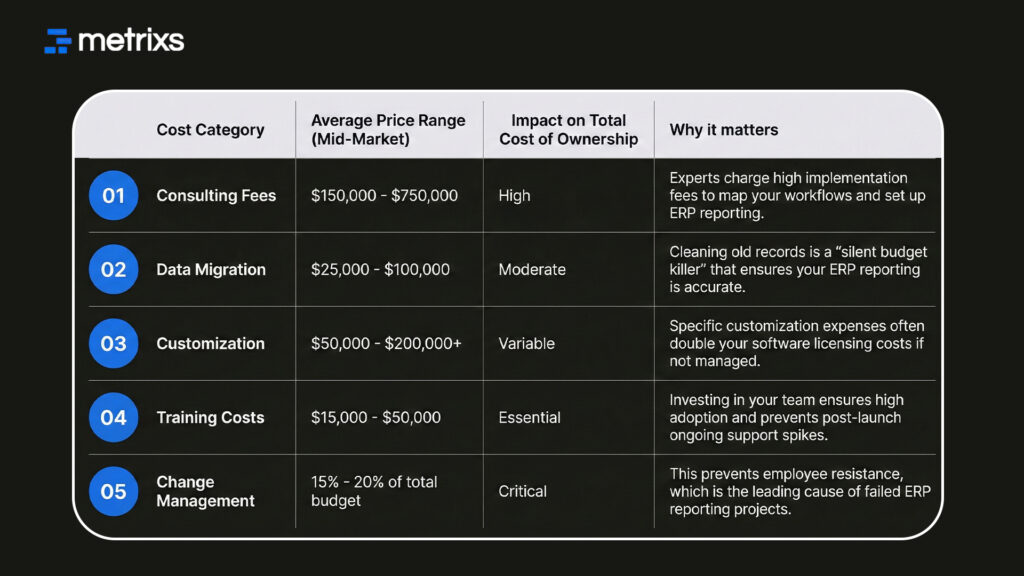
Moving your old records into a new system is a massive task. Data migration is often the “silent budget killer” because old data is usually messy. You have to clean, fix, and map every entry to ensure your future ERP reporting is accurate.
Integrating your ERP with your CRM or email adds more to your ERP costs. Each connection can cost $5,000 to $15,000. The price depends on the complexity of the data flow. Without clean data, your ERP reporting dashboards will show incorrect numbers.
3. Scope Creep and Change Management Underestimation
Many projects suffer from scope creep. This adds 15% to 30% to your final bill. It happens when you keep adding new features during the build. Budget overruns often follow these changes.
You also need to pay for training costs to help your team learn the new tools. Good change management ensures people actually use the ERP reporting software. This requires a budget of 15% to 20% of the total project.
4. Infrastructure and Hardware Investments
On-premise systems need physical servers. Cloud systems avoid these costs but require high-speed connectivity to function.
- Servers and cooling for on-site systems cost $50,000 to $300,000.
- High-speed internet upgrades handle the heavy data for cloud ERP reporting.
If you ignore these needs, your total cost of ownership will spike later. Slow internet can also ruin your ERP reporting speed.
Properly managing these tasks keeps your project on track. After you go live, you must plan for the long-term upkeep of your investment.
A clear breakdown of your implementation expenses reveals where the money really goes. Use this table to track your ERP costs and prevent budget overruns during your ERP reporting setup.
The Hidden Price of Implementation:
Ongoing Maintenance and Support Costs
1. Annual Maintenance and Support Fees
Annual maintenance costs are a permanent part of your budget. If you own on-premise software, expect to pay 15% to 22% of the initial price every year. For a million-dollar system, that means $200,000 just for updates and ongoing support. Cloud users pay for support through monthly fees. These fees ensure your ERP reporting stays secure and functional.
2. System Upgrades and Technology Evolution Costs
Tech changes fast. You need to update your system every few years to keep your ERP reporting accurate. These upgrades can cost $300,000 or more. If you skip updates, you risk security gaps. Modern ERP reporting needs fresh code to handle new data types and AI tools.
3. Staffing and Personnel Costs
You need people to manage the software. Most mid-sized firms spend $500,000 yearly on IT staff. These pros fix bugs and help users with daily ERP reporting tasks. Hiring internal experts prevents budget overruns and reduces extra implementation expenses from constant outside fixes.
4. Infrastructure Maintenance and Hosting
Hosting your data requires power and hardware upkeep. For on-premise systems, hardware repairs and server refreshes are common. Cloud users avoid these physical ERP costs, but they must pay for growing data storage needs. Both paths require a plan for the total cost of ownership to ensure long-term success.
Keeping your system healthy ensures your data stays useful. Next, we see how to turn these expenses into a real advantage for your business.
Maximize ERP ROI Through Automated Reporting with Metrixs
Metrixs offers the most advanced analytics for Microsoft Dynamics 365 Finance & Operations. It lowers your ERP costs by automating complex tasks and ensuring your ERP reporting is 80% faster.
- Rapid Integration: Start within six weeks to minimize your implementation expenses.
- On-Demand Snapshots: Capture trends instantly for better ERP reporting and decision-making.
- Centralized Oversight: Automate financial summaries to stop budget overruns.
- Measurable Impact: Reduce operational costs by 15% and track every dollar.
Metrixs ensures your ERP works as a growth engine. Stop struggling with siloed data and start using your ERP reporting to scale your business → Metrixs
Conclusion
ERP reporting costs determine if your system becomes a strategic tool or a financial trap. Many companies struggle with 189% budget overruns and 70% projected failure rates by 2027.
Ignoring implementation fees and hidden costs leads to devastating losses and missed business goals. These disasters often stem from poor data migration and complex, siloed structures. To protect your total cost of ownership, you must move beyond manual tracking.
Metrixs offers a way out by automating ERP reporting and data consolidation. By improving accuracy and uncovering efficiencies, it helps you recoup your implementation expenses and ensures your ERP costs finally deliver the ROI you were promised.
Connect with Metrixs to maximize your ERP reporting value and turn your implementation expenses into a long-term strategic advantage.
FAQs
1. What is total cost of ownership (TCO) in ERP and why does it matter?
Total cost of ownership measures every dollar spent over several years. It combines software licensing, implementation fees, and maintenance costs. You must track these ERP costs to avoid budget overruns. This complete view justifies the price and ensures your long-term success.
2. Why do ERP projects consistently experience massive budget overruns and what are the primary drivers?
Most budget overruns happen because of hidden costs and poor planning. Problems with data migration and customization expenses often double the price. High implementation fees also drain funds. You must manage these implementation expenses carefully to keep your project on track.
3. How do organizations calculate realistic ERP implementation budgets avoiding the 189% cost overrun trap?
Avoid the 189% trap by building a realistic budget today. Allocate funds for software licensing, training costs, and ongoing support. Include a 20% cushion for hidden costs. This approach keeps your total cost of ownership low while improving your ERP reporting quality.
4. How do cloud ERP subscription models compare to on-premise licensing from a total cost perspective?
Cloud systems use subscriptions to lower initial implementation expenses. On-premise requires a large check for software licensing upfront. While cloud includes ongoing support, both models have a similar total cost of ownership over ten years. Your choice affects how you manage ERP costs.
5. What are the most commonly underestimated and hidden ERP costs creating budget overruns?
Companies often forget to budget for data migration and training costs. These hidden costs cause massive budget overruns if ignored. Customization expenses also surprise many buyers. Tracking every part of your total cost of ownership prevents these financial shocks during your setup.
6. How do organizations achieve strong ERP ROI despite massive investments and budget overruns?
You reach ROI by focusing on operational gains. Use ERP reporting to find waste and cut spending. Good ongoing support and employee training reduce maintenance costs over time. This turns high ERP costs into a strategic win that grows your business.

