


Speed drives operations, yet 70% of companies fail to extract value from their data. They rely on reports that are days old. Many teams running Dynamics AX still depend on manual Excel dumps. This creates a “rearview mirror” effect where you know last month’s numbers but remain blind to the present. You must shift from reactive fixes to real-time analytics.
This guide explores how to unlock hidden data within your ERP. We help you automate operational reporting, optimize inventory, and make data-driven decisions. You don’t need new software to gain financial visibility; you just need better access to the Dynamics AX engine you already own.
The Hidden Cost of Manual Operational Reporting
You invested in a dynamic AX to streamline business, yet manual processes likely still hold you back. Reliance on static spreadsheets creates hidden costs that drain profitability and slow down decision-making.
1. The Spreadsheet Trap
Teams often spend more time building reports than fixing problems. A manager spending four hours weekly on data consolidation loses 25 days of productivity a year. This manual effort destroys operational efficiency and turns skilled staff into data entry clerks. It limits your ability to use the Dynamics AX for strategic growth.
2. Data Silos
Departments like finance and logistics often operate in disconnected bubbles. Without unified operational reporting, teams rely on conflicting numbers. Manual entry errors lead to stockouts or overages that go unnoticed until they become a crisis, obscuring true financial visibility. Your ERP should bridge these gaps, not widen them.
3. The Latency Issue
Traditional reports are history lessons. By the time a variance report arrives, the damage is done. You need real-time analytics to catch issues instantly. Dynamics AX holds the data, but manual extraction delays the insight you need to act. A delayed report means you solve yesterday’s problems while today’s fires burn.
These inefficiencies are solvable when you transform a dynamic AX from a static ledger into an active monitoring system.
How Dynamics AX Reporting Transforms Daily Operations
Transforming your daily routine requires moving beyond basic ledgers. Dynamics AX offers powerful tools to shift from passive data collection to active management, ensuring your team reacts to live data rather than stale spreadsheets.
1. From Static PDFs to Live Dashboards
A) Role Centers: Dynamics AX replaces static monthly reports with over 40 standard Role Centers that act as live dashboard analytics.
B) The Benefit: A production manager sees equipment uptime now. A CFO tracks cash flow status today rather than waiting for the month-end.
C) Impact: You reduce response times from days to hours by embedding business intelligence analytics directly into the user’s workspace.
2. Automating the Mundane
A) Eliminate Manual Entry: Operational reporting tools automate the data flow between procurement and inventory modules.
B) Workflow: Instead of manually calculating reorder points, the system uses real-time analytics to trigger alerts automatically.
C) Result: ERP reporting automation frees your team to focus on strategy rather than data entry.
With the mundane tasks automated, you can give your team the power to find their own answers without waiting on IT.
Empowering Teams with Self-Service Analytics
Reporting delays often occur when only IT holds the keys to information. Dynamics AX changes this structure by offering self-service reporting. This capability empowers your operational managers to answer their own questions instantly without logging a support ticket.
1. Breaking the IT Dependency
- The Old Way: You request a custom report, IT puts it in a backlog queue, and you receive the data two weeks later. The opportunity to act passes before you even see the numbers.
- The New Way: Self-service reporting tools allow users to drag-and-drop data fields to query the system directly. You get answers now.
- Efficiency: This accelerates decision cycles and reduces the burden on IT departments. They focus on infrastructure while you focus on data-driven decisions.
Breaking the IT Dependency: A Comparison

2. Custom Views for Custom Problems
- Flexibility: Standard reports rarely fit every unique situation. Dynamics AX allows users to customize their views to solve specific operational reporting challenges.
- Application: A logistics coordinator can build a specific view for “Late Shipments by Carrier.” A sales manager tracks “Margin by Region.” A quality manager creates a dashboard to monitor “Defect Rates by Vendor” to catch supply issues early.
- Value: This ensures that the performance metrics on your screen remain relevant to the specific problem you face right now using real-time analytics.
Once your team can access and customize their own data, they can stop reacting to the past and start predicting the future.
Operational Resilience: Predicting the Future
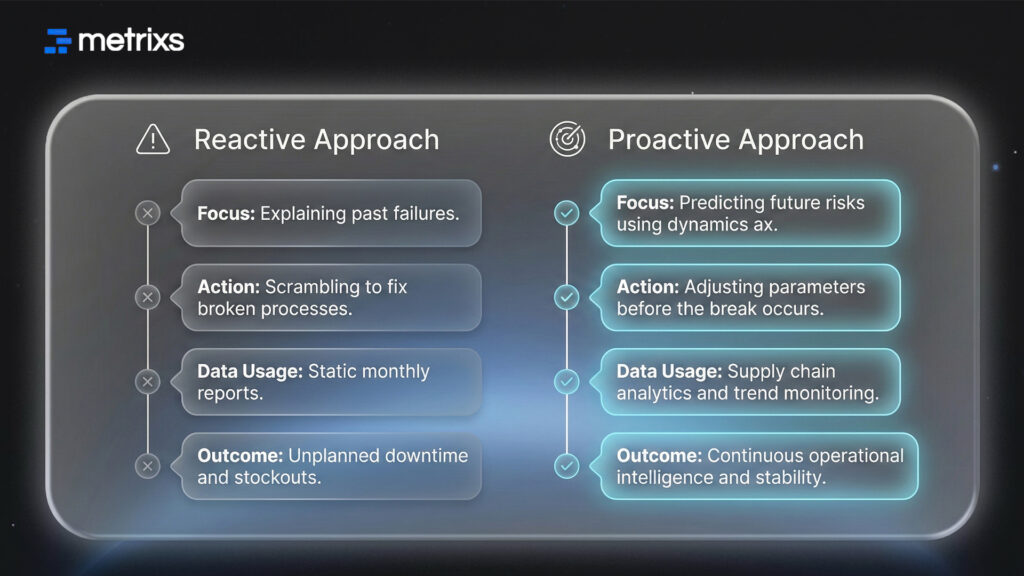
You cannot drive forward looking only in the rearview mirror. True resilience comes when you use a dynamic AX to predict what happens next. You shift from reactive firefighting to proactive prevention.
1. Proactive vs. Reactive
Most teams use data to explain failure. You must use supply chain analytics to prevent it. Dynamics AX contains historical trends that act as early warning signals. You spot the smoke before the fire starts.
- Supplier Risk: You notice a vendor’s lead time creeping up by 10% over two months. You adjust orders before you face a stockout.
- Production Yield: You identify a 5% drop in output on Line A using real-time analytics. You schedule maintenance before you miss a critical deadline.
- Inventory Health: Inventory management reporting highlights slow-moving items before they become dead stock, protecting your cash flow.
Proactive vs. Reactive Operations
2. Automating Compliance
Audits often cause panic. They shouldn’t. Compliance reporting within the dynamics AX ensures you remain audit-ready every day. You automate the monitoring of quality standards. This delivers continuous operational intelligence without manual checks. You prove adherence to regulations instantly, not after a frantic week of gathering papers.
When you can predict trends and automate compliance, you expose the final hurdle: the difficulty of extracting these insights from a complex ERP without external help.
How Metrixs Solves the Operational Reporting Paradox
Metrixs delivers advanced analytics and reporting insights specifically for Microsoft Dynamics. It helps enterprises consolidate data seamlessly. You transform raw numbers into a unified view of Dynamics AX performance across finance, inventory, and operations.
With a comprehensive library of 1,000+ metrics and 100+ pre-built reports, Metrixs enables 80% faster operational reporting and 99.9% data accuracy. It eliminates manual inconsistencies and siloed data. This ensures your ERP serves as a growth engine rather than just a data collector.
Key Strengths:
- Rapid Integration: Get up and running in under six weeks with a seamless dynamic AX implementation that minimizes business disruption.
- On-Demand Data Snapshots: Instantly capture historical trends, workforce shifts, and inventory flows for proactive real-time analytics.
- Multi-Region Flexibility: Effortlessly track multiple currencies and units of measurement to ensure consistent compliance reporting across global locations.
- Centralized Financial Oversight: Automate balance sheets and financial summaries to reduce manual work and maintain a real-time view of financial visibility.
- Measurable Impact: Smart insights help reduce operational costs by 15% and optimize resource allocation within your supply chain analytics strategy.
Metrixs turn data into a competitive advantage. It provides the clarity and speed businesses need to scale efficiently. Ready to transform your reporting? Discover Metrixs today.
Conclusion
Dynamics AX functions as a robust engine, but an engine needs a dashboard. Too often, native reporting tools lock valuable data behind complex queries. This rigidity forces teams to rely on outdated spreadsheets.
The cost of this lag is high. Delayed insights lead to missed opportunities, stockouts, and financial blind spots. If you base decisions on old data, you risk steering your operation off a cliff.
Metrixs removes this risk. It bridges the gap to automate operational reporting, providing the clear, real-time analytics you need to ensure your dynamic AX investment actually drives growth.
Let’s book a demo with Metrixs and see how fast your data can work for you.
FAQ
1. Can non-technical users build reports in Dynamics AX?
Modern tools empower you to bypass IT completely. With self-service reporting, users drag-and-drop fields to create custom views instantly. You don’t need coding skills to generate operational reporting insights. This accessibility ensures everyone leverages dynamic AX data to drive faster, data-driven decisions without technical delays.
2. How does real-time reporting improve inventory management?
It kills the lag between sales and restocks. Real-time analytics offer immediate views of stock levels, preventing costly stockouts. By updating inventory management reporting instantly, you avoid overstocking and ensure operational efficiency. You act on live numbers, keeping your supply chain lean and responsive.
3. Is it difficult to integrate Dynamics AX with other BI tools?
Not at all. Dynamics AX connects naturally with the Microsoft ecosystem, including Power BI. You visualize performance metrics seamlessly without building complex connectors. This integration simplifies business intelligence analytics, giving you a unified view of your data without the headache of expensive custom development.
4. How quickly can we see ROI from reporting automation?
You see results fast. Most teams cut report generation time by 75% in the first month using ERP reporting automation. Immediate savings appear quickly. Strategic wins, like lower inventory costs and better financial visibility, typically follow within a quarter as your operational intelligence fully matures.
5. Does this work for multi-region operations?
Yes, it scales globally. Dynamics AX manages multiple currencies and complex compliance reporting requirements effortlessly. It ensures consistent operational intelligence across every branch. You maintain a single version of the truth, making it easy to standardize dashboard analytics regardless of where your offices are located.

