

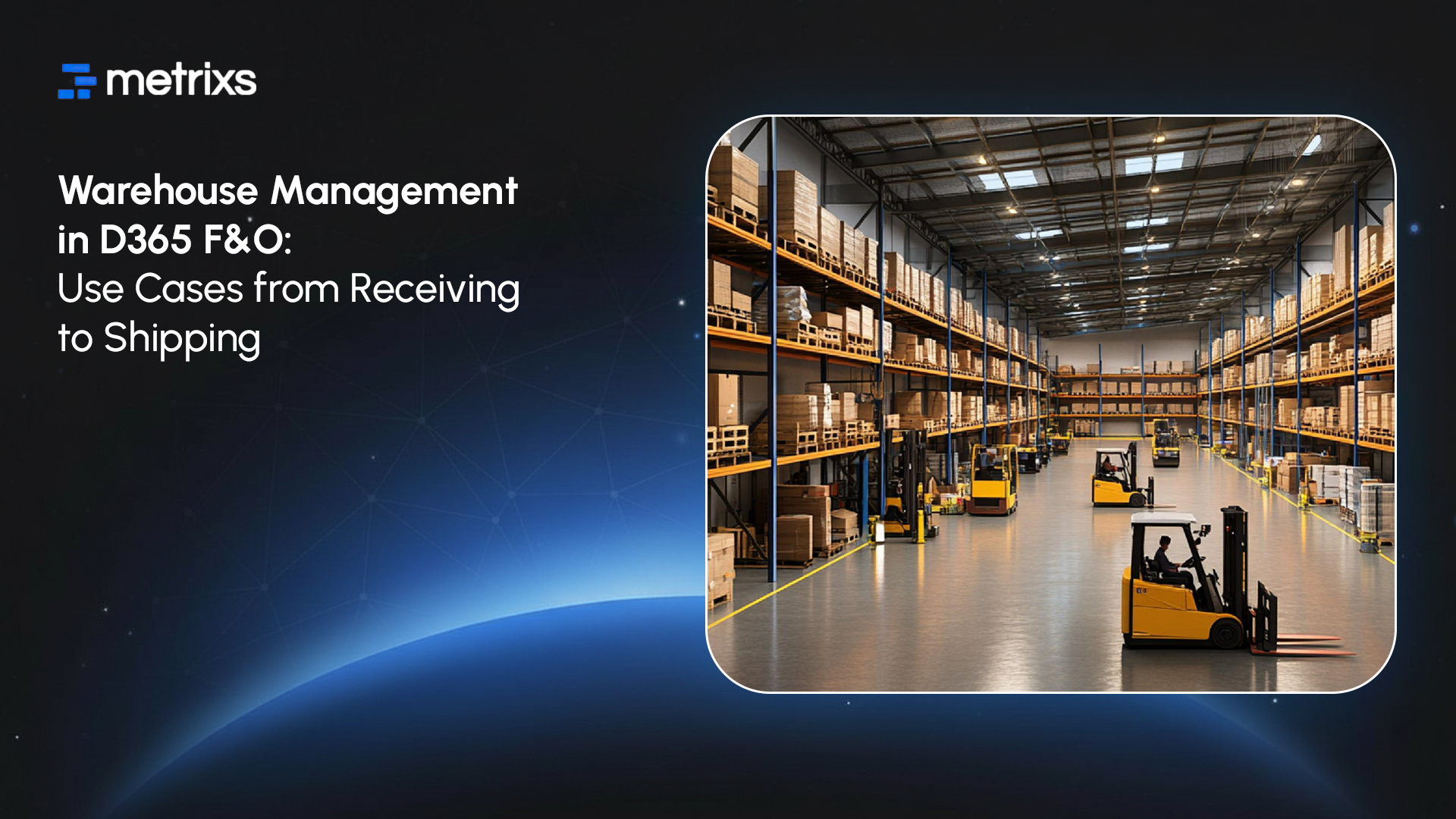
A warehouse worker scanning a barcode on a handheld device never actually decides where to pick from or where to put something away. That decision was already made, configured well before the worker’s shift started. D365 warehouse management is really a set of rules deciding warehouse work in advance, with the mobile app simply the place those rules finally become a visible task.
This guide will explore how D365 warehouse management actually structures receiving, put-away, wave processing, and picking through four core configuration objects, how mobile workflows turn that configuration into guided work, and where warehouse analytics still needs more than what ships natively.
Every task a worker sees was decided before the shift started
Four configuration objects do the actual deciding in D365 warehouse management: location directives determine where to pick from or put away to, work templates define what work gets created and require at least one pick and one put operation, wave templates group orders for coordinated release, and work pools organize how that work gets distributed among workers.
- None of these four are visible to a worker holding a scanner. What the worker sees is the output: a specific task, at a specific location, in a specific order.
- Getting D365 warehouse management configuration wrong rarely shows up as an error message. It shows up as a worker walking further than necessary, or picking in an order that makes packing harder later.
This is why warehouse go-lives so often succeed technically while still underperforming operationally. Every location directive validated, every wave template tested, and the system runs exactly as configured. Whether that configuration actually reflects how the physical building works, which aisles bottleneck during peak volume, which pick paths cross each other, is a separate question D365 warehouse management cannot answer on its own.
Receiving and put-away: location directives and license plates
License plates are the tracking mechanism underneath receiving. A license plate is a unique identifier assigned to a group of items, so a pallet or container can move through the warehouse as one unit instead of tracking every item individually. License plate receiving enhancements let receiving happen at any warehouse location rather than only the default location the warehouse was originally configured with.
- License plates can be nested, a parent license plate with child license plates assigned underneath it, so a worker can move a larger consolidated group of inventory in a single action instead of handling each child individually.
- Location directives decide where each received item actually gets put away, based on product attributes, storage characteristics, or urgency, so put-away follows a consistent rule rather than whichever empty spot a worker happens to notice first.
A fast-moving item and a slow-moving item arriving on the same receiving dock rarely belong in the same part of a warehouse, and a well-tuned location directive is what actually enforces that separation without a supervisor manually redirecting each pallet.
Location directives and license plates generate a steady stream of receiving data most warehouses never look back at once the pallet is put away. The Metrixs analytics suite is what actually makes that history usable.
Wave processing: turning many orders into one coordinated release
Wave processing is what groups eligible outbound orders together and releases them to the warehouse as one coordinated batch instead of one picking list at a time. A wave template is selected based on a sequence: the system checks the criteria in the first template in the sequence, and if they match, that template processes the wave; if not, it checks the next template in line.
- Each wave template specifies its own wave process methods, and D365 warehouse management supports multiple wave template types depending on how outbound work actually needs to be released.
- Wave processing is where shipping method, priority, and delivery date actually translate into which orders get picked together, rather than each order competing independently for warehouse attention.
The sequence logic matters more than it looks at first glance. A wave template sequence built around outdated shipping priorities will keep matching orders to the wrong template long after the business priorities behind it have changed, since the system has no way to know the sequence itself needs revisiting. It simply keeps checking the criteria it was given, in the order it was given them.
Picking, packing, and mobile workflows
The Warehouse Management mobile app is where wave templates, work templates, and location directives finally become a task a person can act on. A stated design goal of the mobile picking flow is minimizing how much a worker has to scan or key in manually, so fields are prepopulated or skipped entirely wherever the system can determine the answer on its own.
- Barcode and QR scanning, directed picking and packing, cycle counting, and inventory adjustments all run through the same mobile workflows, guiding a worker through each step without requiring any ERP knowledge.
- Offline operation is supported for intermittent connectivity, syncing transactions once the connection returns, which matters most in large facilities with real dead zones.
The prepopulation design goal is worth appreciating on its own terms. D365 warehouse management could have built a mobile flow that asks a worker to confirm every field on every scan, and technically that would be more thorough. Instead, it asks only what the system genuinely cannot determine on its own, a deliberate trade of theoretical completeness for a meaningfully faster, less error-prone worker experience.
If mobile workflows keep prompting workers for information the system should already know, a Metrixs consulting review can trace whether that is a configuration gap or a genuine data gap.
Where pick efficiency still needs more than what ships natively
D365 warehouse management captures enormous detail on every pick, pack, and put-away. Power BI integration exists for warehouse performance metrics, but pick efficiency itself, how long a wave actually took, how many lines a worker completed per hour, how that compares week to week, is rarely a single native report. It has to be derived from work transaction timestamps most teams never think to query directly.
- Warehouse analytics built this way tends to live in whichever report someone happened to build for a specific question, not a consistent, ongoing view.
- Comparing pick efficiency across warehouses, or across a full fiscal year rather than the current week, usually means exporting work transaction history and building the comparison manually.
Seasonal businesses feel this gap the most acutely. A retailer wanting to compare this year’s peak-season pick efficiency against last year’s, to know whether last year’s staffing model actually worked, needs two full seasons of work transaction history lined up side by side, a comparison native tools were never built to hold for that long.
| What you need | Native D365 F&O tools | A dedicated layer such as Metrixs |
|---|---|---|
| Pick efficiency trend by worker or warehouse | Derived manually from work transactions | Configurable history in one saved view |
| Wave performance across a full fiscal year | Built ad hoc per question | Held as an ongoing trend |
| Cross-warehouse and cross-entity comparison | Assembled by hand, warehouse by warehouse | Consolidated automatically |
| Refresh | As current as the last completed wave | 15 to 30 minutes via Synapse Link |
How Metrixs extends D365 warehouse management reporting
Metrixs reads wave history, work transactions, location directive activity, and mobile device task data through Azure Synapse Link into the same dedicated Azure Data Lake used for the rest of D365 F&O, built across more than 6,000 backend tables.
- Pick efficiency, wave duration, and worker productivity held as configurable history, so a quarter-over-quarter trend is a saved report, not a manual export.
- Cross-warehouse and cross-entity comparison consolidated automatically, including across a multi-entity or multi-ERP environment.
- Refresh every 15 to 30 minutes, inside the same 12-module, 150+ report, 1200+ metric suite, most deployments live in under 6 weeks, client ROI 290% to 450%.
D365 warehouse management still generates and executes every wave, pick, and put-away correctly on its own. Metrixs is where that data finally becomes a trend a manager can actually watch move, well beyond a transaction log reviewed one wave at a time.
Pick efficiency by worker, wave performance by warehouse, all held as history instead of rebuilt every time someone asks. See it in the D365 F&O finance and accounting analytics use case.
Frequently asked questions
What are the core configuration objects in D365 warehouse management?
Location directives, work templates, wave templates, and work pools are the four core objects. Location directives decide pick and put locations, work templates define what work is created, wave templates group orders for release, and work pools organize how work is distributed among warehouse workers.
What is a license plate in D365 F&O?
A license plate is a unique identifier assigned to a group of items, letting a pallet or container move through the warehouse as a single tracked unit. License plates can also be nested, with child license plates assigned to a parent, so a worker can move a larger consolidated group in one action.
How does wave processing work in D365 warehouse management?
Wave processing groups eligible outbound orders and releases them together based on criteria such as shipping method, priority, or delivery date. The system selects a wave template by checking a defined sequence of templates in order, applying the first one whose criteria are actually met.
What mobile workflows does the D365 warehouse management app support?
The mobile app supports barcode and QR scanning, license plate receiving and put-away, directed picking and packing, cycle counting, and inventory adjustments, with offline operation for intermittent connectivity. A core design goal is minimizing manual scanning and keying by prepopulating fields wherever possible.
Does D365 F&O calculate pick efficiency automatically?
Not as a single native report. Power BI integration surfaces general warehouse performance metrics, but pick efficiency specifically, wave duration, lines completed per hour, trend over time, usually has to be derived from work transaction data rather than pulled from one dedicated page.
Can D365 F&O compare warehouse analytics across multiple sites?
Not as a single native view. Wave history, work transactions, and location directive activity are generally scoped to one warehouse or legal entity at a time, so comparing warehouse analytics across sites usually means exporting from each one and reconciling the results by hand.
The verdict
D365 warehouse management genuinely handles the mechanics: location directives and license plates that govern receiving and put-away, wave templates that coordinate outbound release, and mobile workflows that turn all of it into guided, low-friction tasks for warehouse workers.
Where it stops is the trend view: pick efficiency, wave performance, and warehouse analytics held as history, compared across warehouses and entities at once. Metrixs closes that gap, reading the same wave and work transaction data, refreshing every 15 to 30 minutes, and shipping it as part of the same suite that already covers general ledger, budgeting, and inventory.
Ready to see your own pick efficiency and wave performance as one connected view? Book a Metrixs reporting assessment, and we will map your warehouse configuration against what the reporting layer already covers.
Related reading: Transportation management in D365 F&O: freight, routing, and cost use cases

