


Most companies built their tech around one idea. They thought they could wait for a batch processing cycle to finish before making a choice. That idea fails today. An operational data warehouse fixes the traditional BI limitations that slow you down.
A normal setup takes hours to update. An operational data warehouse gives you data freshness in seconds. You need real-time data analytics to stay ahead. Waiting for a data pipeline to run overnight costs you money.
Fast access to your data improves your business performance by 21%. 72% of IT leaders now use streaming tech for daily work.
What traditional BI is actually built for and what it’s not
Traditional BI works well for one thing: looking backward. It helps you see trends over months or years. But using it for daily tasks shows its traditional BI limitations. An operational data warehouse fills the gap that old systems leave behind.
1. The batch processing model and where it holds
Standard tools use batch processing to move data. This means your data pipeline only runs at set times, like midnight. This works for:
- Quarterly sales reviews.
- Yearly budget planning.
- Static reports that don’t change by the hour.
If you don’t need data freshness, this old model stays relevant.
2. The hidden latency problem most teams don’t track
The problem starts when you need to act fast. High data latency ruins your chance to fix a live issue. By the time your system loads, the information is stale. An operational data warehouse stops this delay. Most teams ignore how long a report sits unused while a crisis grows.
3. When the BI stack gets overloaded with operational queries
When teams try to run real-time data analytics on an old stack, the system breaks. Pushing low-latency queries into a slow database causes lag for everyone. You need an operational data warehouse to handle these daily tasks without crashing your main reports.
Using an operational data warehouse keeps your business moving. This lag forces you to look at a better way to handle your needs.
How an operational data warehouse handles real-time data analytics differently
The architectural difference between an operational data warehouse and a traditional BI stack isn’t cosmetic. It determines what questions your data can answer and how fast you can answer them.
Using an operational data warehouse changes your real-time data analytics from a goal into a daily reality.
1. Continuous ingestion vs. Scheduled batch loads
An operational data warehouse pulls data the moment it happens. It doesn’t wait for a data pipeline to run at midnight. Instead, it uses streaming data to keep your records current.
- ERP integration happens in seconds, not hours.
- You see shipment status updates the moment they occur.
- Data freshness stays high because the system never stops loading.
2. Low-latency query optimization built into the core
While old systems focus on volume, an operational data warehouse focuses on speed. It handles low-latency queries by using advanced indexing and materialized views. This means:
- You get results in milliseconds, even with massive datasets.
- Logistics teams can track thousands of live orders at once.
- Your operational data store doesn’t slow down when everyone asks a question.
3. Structured data from hybrid sources without schema limitations
An operational data warehouse handles different types of data without a struggle. Traditional BI usually needs weeks of engineering to change a schema. This new setup processes the following:
- Standard tables from your ERP integration.
- Semi-structured files from cloud storage.
- Unstructured feeds from live sensors.
This flexibility ensures your real-time data analytics include every part of your business, not just the easy parts.
By changing the architecture, you remove the barriers that keep your team in the dark.
The specific use cases where operational data warehouse architecture wins
These aren’t edge cases. These are the exact scenarios where enterprises are actively replacing traditional BI setups with an operational data warehouse.
1. Financial fraud detection and real-time risk flags
Traditional BI batch processing cannot catch fraud in the transaction window. By the time an anomaly appears in the next scheduled load, the event has already occurred. An operational data warehouse processes transaction data as it arrives.
- It applies anomaly detection rules in real-time.
- It triggers automated responses to block a transaction.
- It alerts a compliance team within the same operational window. For financial institutions, the cost of missing this window is not abstract. Delayed detection translates directly into irreversible financial loss.
2. Live inventory and supply chain visibility
Inventory decisions made on yesterday’s data create compounding errors like stockouts and over-ordering. An operational data warehouse surfaces inventory movement and fulfillment status continuously.
- It gives procurement teams a view of current reality.
- It eliminates version-control problems in multi-location entities.
- It ensures everyone makes decisions from the same data freshness level.
3. Operational reporting for live financial close monitoring
Month-end close processes that rely on old dashboards work with data that lags behind actual progress. An operational data warehouse connected to your ERP integration reflects journal entry approvals and reconciliation completions as they happen. This gives finance controllers a live, close status view rather than a scheduled summary.
4. Operational architecture: ODW vs. Traditional BI
A side-by-side comparison shows why an operational data warehouse handles real-time data analytics while traditional setups struggle.
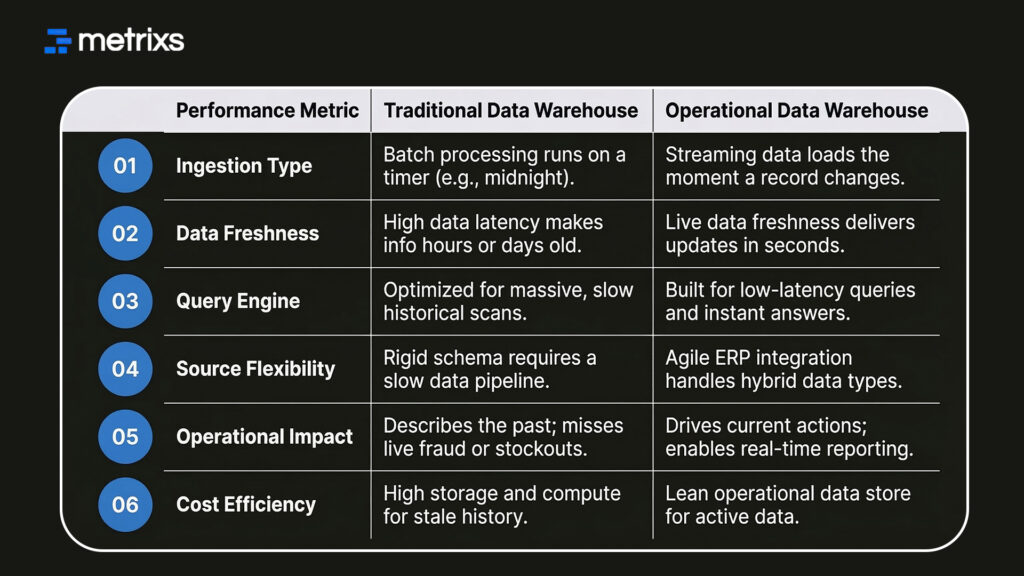
By focusing on these high-stakes areas, you turn your data into a tool for immediate action.
How Metrixs replaces traditional BI with operational data warehouse intelligence
Metrixs transforms Microsoft Dynamics 365 Finance & Operations into a high-speed operational data warehouse. It consolidates raw ERP numbers into a unified view of your business performance.
By using a library of 1200+ metrics, Metrixs delivers 80% faster real-time data analytics with 99.9% accuracy.
- Rapid Integration: Deploy a full operational data warehouse in under six weeks.
- On-Demand Snapshots: Capture data freshness for instant inventory and workforce shifts.
- Multi-Region Flexibility: Track global ERP integration across multiple currencies effortlessly.
- Centralized Oversight: Automate financial summaries for a live operational data store view.
Metrixs ensures your ERP acts as a growth engine rather than a stagnant data collector. Explore how Metrixs ensures you use your ERP to its full advantage and simplifies your operational data warehouse.
Conclusion
Traditional BI fails because the speed of 2026 operations outpaced batch architecture. Relying on stale reports creates a high data latency gap that hides active risks.
When you act on yesterday’s data, you miss fraud, lose inventory, and bleed revenue to competitors using real-time data analytics. This delay is a structural failure that leaves you blind during critical shifts.
An operational data warehouse closes this window. Metrixs delivers this data freshness for Dynamics 365, turning your ERP into a live growth engine in weeks.
Connect to Metrixs to start your operational data warehouse setup and gain real-time data analytics for your entire team today.
FAQs
1. What is an operational data warehouse, and how does it differ from a traditional data warehouse?
An operational data warehouse provides real-time data analytics by ingesting streaming data instantly. Unlike batch processing in a traditional data warehouse, it prioritizes data freshness. This allows for low-latency queries that answer “What is happening now?” rather than “What happened yesterday?”
2. When does traditional BI still make sense over an operational data warehouse?
Traditional BI works for long-term trends where data latency isn’t a problem. If your data pipeline only needs to support quarterly reviews, the old model holds. Use an operational data warehouse only when your decisions require immediate, live real-time reporting.
3. What are the biggest technical differences in how each system handles queries?
Old systems focus on moving large volumes slowly. An operational data warehouse uses an operational data store architecture to handle low-latency queries in milliseconds. This setup ensures real-time data analytics remain fast even when your ERP integration processes thousands of updates.
4. Is an operational data warehouse more expensive to build and maintain?
An operational data warehouse often costs less because it focuses on current data. By avoiding the storage of decades of history, your data pipeline stays lean. The savings grow when you stop losing money to decisions made on stale, slow information.
5. What industries benefit most from operational data warehouse architecture?
Finance, retail, and logistics see the biggest wins from data freshness. These fields need an operational data warehouse to catch fraud or track inventory instantly. Fast ERP integration ensures these businesses react to market shifts before their competitors even see the data.
6. How does Metrixs deliver operational data warehouse capabilities for Dynamics 365 environments?
Metrixs turns your ERP into a live operational data warehouse in under six weeks. It uses 1200+ metrics to bypass the slow data pipeline build phase. You get 99.9% accuracy and real-time data analytics without the usual traditional BI limitations.

