

Finance teams face a data problem. Most organizations struggle with ERP reporting because their financial information lives in scattered systems. Manual processes slow down financial consolidation reporting, and cash flow forecasting remains unreliable for the majority of finance departments.
The ERP reporting market continues growing because companies need better visibility into their finances. This guide explains ten types of ERP reports that turn fragmented data into clear decisions. Master these reports, and your team gains control over profitability, liquidity, and compliance.
The five core financial statement reports
Every finance function depends on five foundational reports. These financial statement consolidation documents provide the baseline for all other analysis. Your ERP reporting tools generate these statements automatically, but understanding what they show and why they matter separates reactive teams from strategic ones.
1. Consolidated financial statements – the unified view
These combine parent and subsidiary results into one financial picture. They remove intercompany eliminations and provide accurate group-level reporting. Financial consolidation reporting happens monthly for most organizations; quarterly cycles support regulatory filings.
Manual consolidation increases error risk and delays closing. Automated ERP reporting systems and dedicated financial consolidation software reduce manual dependency and speed up the entire process.
2. General ledger reports – the foundation
Every financial report originates from the general ledger. GL reports validate accuracy, support audits, and help finance teams reconcile discrepancies across accounts. 93% of finance teams use multiple software tools, which complicates GL standardization.
ERP reporting tools eliminate re-entry, automate calculations, and enforce approval workflows. They create audit trails that support both internal reviews and external examinations.
3. Income statement – profitability visibility
This shows whether your company operates profitably. Monthly income statements track performance trends; quarterly and annual versions support formal reporting. Real-time financial reporting through ERP reporting systems lets management respond faster to revenue gaps or cost overruns.
Automated systems ensure consistent revenue recognition across all entities, removing the variability that comes from manual processes.
4. Balance sheet – financial health snapshot
The balance sheet shows assets, liabilities, and equity at a specific moment. It helps teams evaluate liquidity, solvency, and overall financial position. Balance sheet accuracy depends entirely on upstream data quality.
ERP reporting tools standardize valuation methods across subsidiaries and automate reconciliation processes. This reduces the errors that typically show up in manually compiled balance sheets.
5. Cash flow statement – where cash really moves
Cash flow statements break down cash from operating, investing, and financing activities. Many profitable organizations still fail due to cash shortages. 37% of mid-market CFOs manage businesses on unreliable forecasts.
ERP reporting integration connects AR, AP, payroll, and inventory data. Real-time cash visibility prevents liquidity crises before they threaten operations.
Variance analysis and performance tracking reports
Variance analysis reporting and performance dashboards tell you what’s actually happening versus what should happen. These management reporting dashboards surface problems early and highlight opportunities before they disappear. Real-time financial reporting through these tools changes how finance teams operate.
6. Variance analysis reports – actual vs. Budget
These reports compare performance against expectations. Variances highlight overspending, revenue gaps, or efficiency opportunities. Most finance teams run variance analysis reporting monthly during close cycles. High variability environments need weekly or biweekly reviews.
66% of organizations report improved efficiency through ERP reporting systems. Automated variance tracking reduces manual effort. ERP reporting dashboards surface trends instantly, helping finance teams identify cost reduction opportunities faster than spreadsheet-based processes ever could.
7. KPI dashboards – real-time performance
Management reporting dashboards turn raw ERP reporting data into fast, visual insights. Common finance KPIs include:
- AR aging analysis
- Inventory turnover rates
- Gross margin percentages
- Working capital positions
Dashboards help teams act before problems escalate. 70% of CIOs prioritize predictive analytics for competitive advantage. Real-time financial reporting through operational reporting metrics supports immediate decisions.
ERP reporting dashboards eliminate manual report compilation. Finance teams gain visibility without IT dependency.
Planning and forecasting reports
Budget forecasting analysis and cash predictions separate prepared organizations from reactive ones. These ERP reporting functions connect historical performance with future planning.
Your cash flow forecasting accuracy determines whether you can fund growth or scramble for emergency financing.
8. Cash flow forecasting – predicting liquidity
ERP reporting systems connect AR, AP, payroll, and inventory data for prediction. Companies with good cash flow forecasting achieve 90% quarterly accuracy.
Cash flow forecasting accuracy drops 19% as entities, bank accounts, and currencies increase. Forecasting helps teams prepare for seasonal variations, payment delays, and investment needs. Automated ERP reporting eliminates spreadsheet errors. Real-time data access enables continuous forecast refinement.
9. Budget and rolling forecast reports – staying agile
Rolling forecasts update projections regularly and help organizations adjust strategy quickly. ERP reporting-driven forecasts reduce manual dependency and speed budget forecasting analysis. Finance teams model growth initiatives and key account impacts rapidly.
Integrated planning tools automate consolidation, generation, and reporting activities. Organizations extend budget forecasting analysis horizons to 90 days with strong accuracy. ERP reporting systems feed rolling Re-forecasts automatically. Finance teams respond faster to market changes.
Compliance and regulatory reporting
Regulatory reporting requirements force finance teams to maintain strict documentation standards. Compliance reporting demands accuracy, consistency, and audit trails. ERP reporting automation handles much of this burden, but your team still needs to understand the underlying standards.
10. Regulatory and compliance reports – meeting mandatory requirements
These include tax reports, audited statements, and industry-specific filings. 75% of organizations improved compliance reporting through ERP reporting systems. Regulatory reporting requirements cover:
- Quarterly and annually audited financial statements
- Tax return preparation and filing
- Capital and liquidity reports for banks
- Internal control documentation
ERP reporting tools automate processes, create audit trails, and reduce preparation time for external reviews. Consolidation adjustments become simpler when systems handle GAAP and IFRS differences automatically.
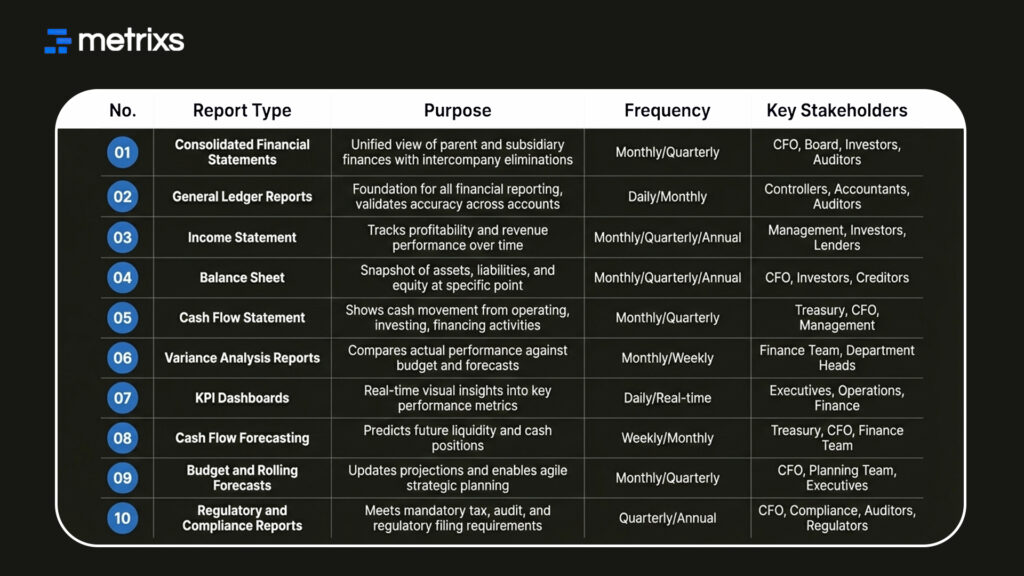
Quick Reference: 10 Essential ERP Report Types
How Metrixs can help you master ERP reporting
Metrixs delivers the world’s most advanced analytics and reporting insights specifically for Microsoft Dynamics 365 Finance & Operations. It helps enterprises consolidate data seamlessly, transforming raw ERP reporting numbers into a unified view of financial consolidation reporting performance across finance, inventory, and operations.
With a comprehensive library of 1200+ metrics and 150+ pre-built reports, Metrixs enables 80% faster ERP reporting and 99.9% data accuracy. It eliminates manual inconsistencies and siloed data, ensuring your ERP reporting tools serve as a growth engine rather than just a data collector.
Key strengths:
- Rapid Integration: Get up and running in under six weeks with a seamless ERP reporting implementation that minimizes business disruption.
- On-Demand Data Snapshots: Instantly capture historical trends, cash flow forecasting patterns, and operational reporting metrics for proactive decision-making.
- Multi-Region Flexibility: Effortlessly track multiple currencies and units of measurement to ensure consistent financial consolidation reporting across global locations.
- Centralized Financial Oversight: Automate balance sheets and financial data analysis summaries to reduce manual work and maintain a real-time view of compliance reporting.
- Measurable Impact: Smart insights help reduce operational costs by 15% and optimize resource allocation within your budget forecasting analysis strategy.
Metrixs turn data into a competitive advantage, providing the clarity and speed businesses need to scale efficiently. Explore how Metrixs ensures you use your ERP reporting to its full advantage and simplifies financial consolidation reporting → Metrixs.
Conclusion
ERP reporting is more than a technical function. Finance teams that understand these ten types of ERP reports gain visibility into profitability, liquidity, and compliance reporting. Automated ERP reporting replaces fragmented spreadsheets and delivers real-time financial reporting insights.
The goal isn’t running more reports but running the right ones consistently. Start by reviewing which reports your team already uses, identify gaps, and build a disciplined framework. Most teams already have ERP reporting tools.
The challenge is turning data into decisions fast enough to matter. Metrixs helps organizations transform financial consolidation reporting from compliance tasks into strategic capability.
Contact Metrixs to improve your ERP reporting decisions.
FAQs
1. What’s the difference between consolidated and unconsolidated financial statements?
Unconsolidated statements show individual entity performance. Consolidated financial statements combine parent and subsidiary results into unified financials. Intercompany eliminations remove internal transactions. Financial consolidation reporting is required for public companies and provides accurate group-level financial data analysis. ERP reporting tools automate this entire consolidation adjustments process.
2. How often should finance teams run variance analysis reports?
Monthly variance analysis reporting aligns with financial close cycles. High variability environments require weekly or biweekly reviews. ERP reporting automation enables more frequent variance analysis reporting monitoring. Real-time financial reporting dashboards surface variances immediately. Review frequency depends on business volatility and stakeholder reporting needs for operational reporting metrics.
3. Which ERP reports are required for regulatory compliance?
Public companies file audited financial statement consolidations quarterly and annually. Banks require capital and liquidity reports. All companies need GL accuracy and internal control documentation. Industry-specific regulatory reporting requirements dictate additional compliance reporting. ERP reporting tools maintain audit trails for regulatory examinations. Compliance reporting requirements vary by jurisdiction and industry.
4. How do ERP systems improve financial reporting accuracy?
ERP reporting eliminates re-entry and automates calculations. Systems enforce approval workflows and create audit trails. 98% of finance teams experience data integration challenges without proper ERP reporting tools. Accuracy improves when financial data analysis is structured and validated at the source. ERP reporting standardizes processes across entities and reduces human error in financial consolidation reporting.
5. Can ERP systems generate forecasts automatically?
Yes. ERP reporting systems combine historical financial data analysis with trend patterns to produce automated cash flow forecasting. Finance teams refine assumptions and evaluate scenarios. AI-powered models reduce error rates by 50% compared to traditional budget forecasting analysis methods. Machine learning analyzes vast datasets and spots subtle patterns. Automated cash flow forecasting eliminates manual spreadsheet dependency.
6. What role do dashboards play in ERP reporting?
Management reporting dashboards provide real-time financial reporting visibility into KPIs. They support operational reporting metrics monitoring. Detailed reports support deeper financial data analysis. Dashboards turn raw ERP reporting data into visual insights. Finance teams act faster on emerging trends through real-time financial reporting. ERP reporting tools reduce time spent compiling manual stakeholder reporting.

